Taweechai Amornsakchai
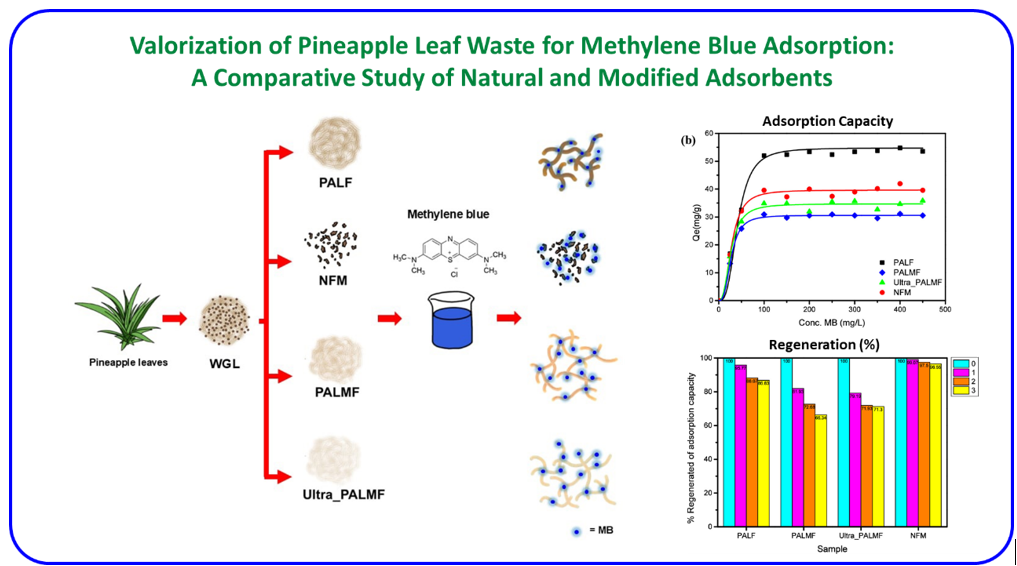
Synthetic dyes such as methylene blue are commonly used in industries like textiles and pharmaceuticals, but they can harm the environment if released into water sources. This study explored how waste from pineapple leaves could be turned into a natural and eco-friendly material to remove these dyes from water. Different forms of the pineapple leaf material were tested, including raw fiber, nonfibrous material, alkali-treated microfibers, and ultrasonically treated fibers. The raw fiber showed the highest ability to capture dye, while the nonfibrous material could be reused several times with little loss in performance. The experiments showed that the dye removal process happened naturally and released some heat. Overall, this study shows that pineapple leaf waste can be used as an effective and reusable material for cleaning dye-contaminated water, offering a sustainable alternative to conventional methods.
Reference:
“Valorization of Pineapple Leaf Waste for Methylene Blue Adsorption: A Comparative Study of Natural and Modified Adsorbents”, Rungrattanachai. C., Amornsakchai, T., Amornsakchai, P., ACS Omega. 2025, 10(41), 48711-48722.
