Vasut Nakarajouyphon, Thanthapatra Bunchuay, Nobuto Yoshinari, Takumi Konno &
Preeyanuch Sangtrirutnugul*
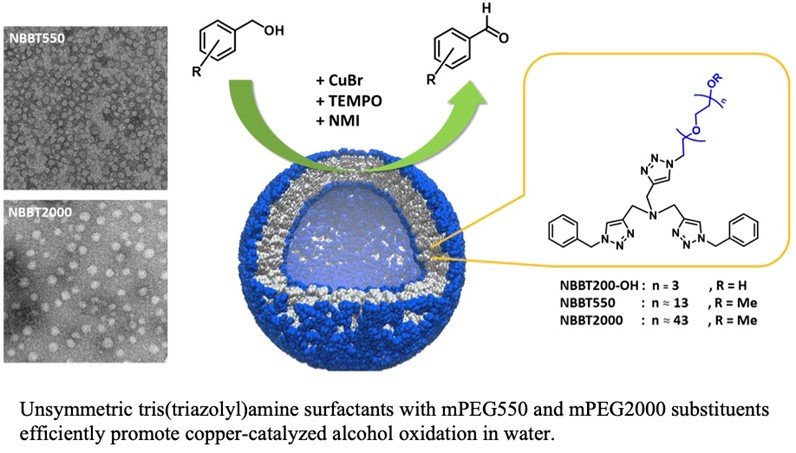
Traditional methods for oxidizing alcohols to aldehydes often involve using large amounts of harsh chemicals such as, for example, sodium hypochlorite (NaOCl) or oxalyl chloride combined with DMSO and triethylamine (NEt3) in organic solvents. To improve production sustainability, developing catalysts that can perform alcohol oxidation under more green conditions is essential. In this report, we introduce a new type of catalyst system consisting of CuBr, N-methylimidazole (NMI), 2,2,6,6-tetramethylpiperidine 1-oxyl (TEMPO), and PEG-substituted tris(triazolyl)amines (PEG = polyethylene glycol; NBBTn). The tris(triazolyl)amines NBBTn (n = 200-OH, 550, 2000) act as both a surfactant and a stabilizing ligand for copper. In particular, the catalyst system with a PEG substituent of average molar mass 550 (NBBT550) showed the highest activity for aerobic alcohol oxidation compared to those with average molar masses of 200 and 2000, i.e., NBBT200-OH and NBBT2000. Our catalyst system CuBr/NBBT550/TEMPO/NMI was shown to be highly efficient in water, selectively converting various activated 1o alcohols to aldehydes in quantitative yields at room temperature. Moreover, the catalyst CuBr/NBBT550 can be reused for at least six cycles without a loss in activity, making it a promising catalyst system for sustainable chemical production.