Preeyanuch Junkong,* Takumi Ohashi, Treethip Phakkeeree, Kosuke Miyaji, Shotaro Iwasaki, Katrina Cornish, and Yuko Ikeda*
เนื้อหา (Plain language Summary)
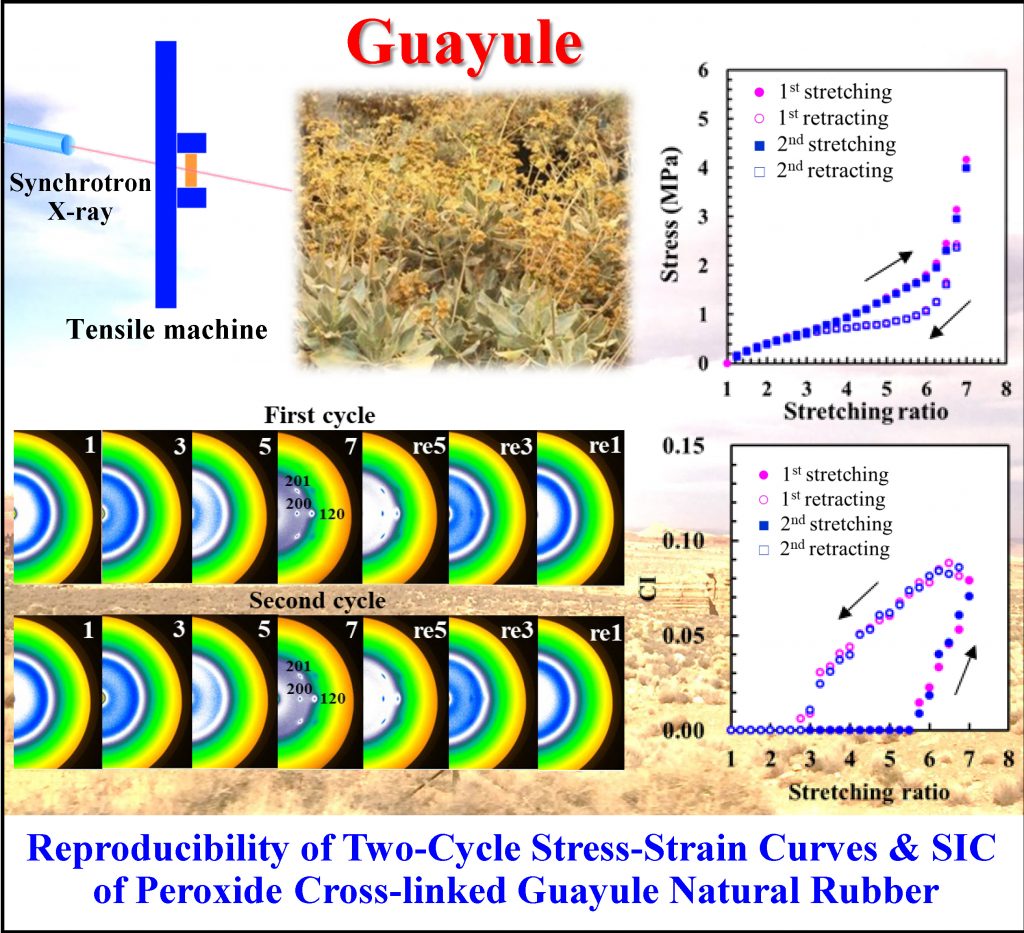
Natural rubber from the guayule crosslinked with peroxide (P-gGR) was prepared from guayule latex that had not been acetone-extracted and had undergone a drying process (gGR). The tensile properties and dynamic mechanical properties of P-gGR with three different crosslink densities were then studied. The results showed that the stress-strain curves from cyclic tensile tests of all samples exhibited highly similar behavior when tested over two cycles. Furthermore, for the first time, strain-induced crystallization (SIC) behavior of P-gGR was measured using wide-angle synchrotron X-ray diffraction, with an X-ray beam exposure of 70 milliseconds every 3 seconds throughout both stretching-retracting cycles. The results revealed that SIC exhibited consistent behavior during both cycles. Additionally, the apparent crystallite sizes, average volumes, indexes of average number, and orientation fluctuations of crystallites showed no significant changes between the stretching-retracting cycles. Non-rubber components such as phospholipids, glycolipids, fatty acid esters, sterols, and terpenes present in gGR had minimal effect on inhibiting SIC during the second cycle of P-gGR and did not contribute to the deterioration of mechanical properties. The consistent behavior of the stress-strain curve and SIC phenomena across two stretching-retracting cycles of P-gGR can be explained by the thermodynamically stable peroxide crosslinks in P-gGR. This study demonstrates that gGR is a promising alternative to Hevea natural rubber for the rubber industry, with the insights gained offering potential applications in the development and production of both conventional and high-performance rubber products.
ยางธรรมชาติจากต้นวายยูเล่ (Guayule) ที่ผ่านกระบวนการเชื่อมขวางด้วยเพอร์ออกไซด์ (P-gGR) ถูกเตรียมจากน้ำยางวายยูเล่ที่ยังไม่ผ่านการสกัดด้วยอะซีโตนและผ่านกระบวนการทำให้แห้ง (gGR) จากนั้นได้ทำการศึกษาสมบัติด้านความทนทานต่อแรงดึงและสมบัติเชิงกลพลวัตของ P-gGR ที่มีระดับความหนาแน่นของพันธะเชื่อมขวางสามระดับ ผลการทดสอบพบว่า กราฟความเค้น-ความเครียด (stress-strain curve) จากการทดสอบแรงดึงแบบยืด-หดของตัวอย่างทั้งหมด แสดงพฤติกรรมที่คล้ายคลึงกันอย่างมากเมื่อถูกทดสอบสองรอบ นอกจากนี้ยังเป็นครั้งแรกที่พฤติกรรมการตกผลึกจากการดึงยืด (Strain-Induced Crystallization: SIC) ของ P-gGR ถูกวัดโดยใช้เทคนิคการเลี้ยวเบนรังสีเอกซ์ซินโครตรอนแบบมุมกว้าง (Wide-angle synchrotron X-ray diffraction) โดยฉายลำแสงที่ตัวอย่างเป็นเวลา 70 มิลลิวินาทีในทุกๆ 3 วินาที ตลอดสองรอบของการทดสอบ พบว่า SIC มีพฤติกรรมที่สอดคล้องกันตลอดการยืด-หดทั้งสองรอบ นอกจากนี้ไม่พบการเปลี่ยนแปลงอย่างมีนัยสำคัญของขนาด ปริมาตรเฉลี่ย ดัชนีจำนวนเฉลี่ยของผลึก และความผันผวนของการจัดเรียงตัวของผลึก ระหว่างรอบการทดสอบ ส่วนประกอบที่ไม่ใช่ยาง เช่น ฟอสโฟลิพิด ไกลโคลิพิด กรดไขมัน เอสเทอร์ สเตอรอล และเทอร์พีน ซึ่งมีอยู่ใน gGR แทบไม่มีผลต่อการยับยั้งการเกิด SIC ในรอบที่สองของการยืด-หด และไม่ทำให้สมบัติเชิงกลเสื่อมลง พฤติกรรมที่สม่ำเสมอของกราฟความเค้น-ความเครียดและปรากฏการณ์ SIC ระหว่างการยืด-หดสองรอบของ P-gGR สามารถอธิบายได้จากเสถียรภาพทางอุณหพลศาสตร์ของพันธะเชื่อมขวางด้วยเปอร์ออกไซด์ใน P-gGR งานวิจัยนี้แสดงให้เห็นว่า gGR เป็นทางเลือกที่มีศักยภาพในการใช้แทนยางธรรมชาติจากต้นยางพารา (Hevea brasiliensis) ในอุตสาหกรรมยางได้ โดยข้อมูลเชิงลึกที่ได้รับสามารถนำไปใช้พัฒนาและผลิตผลิตภัณฑ์ยางทั้งในรูปแบบดั้งเดิมและคุณภาพสูงต่อไป