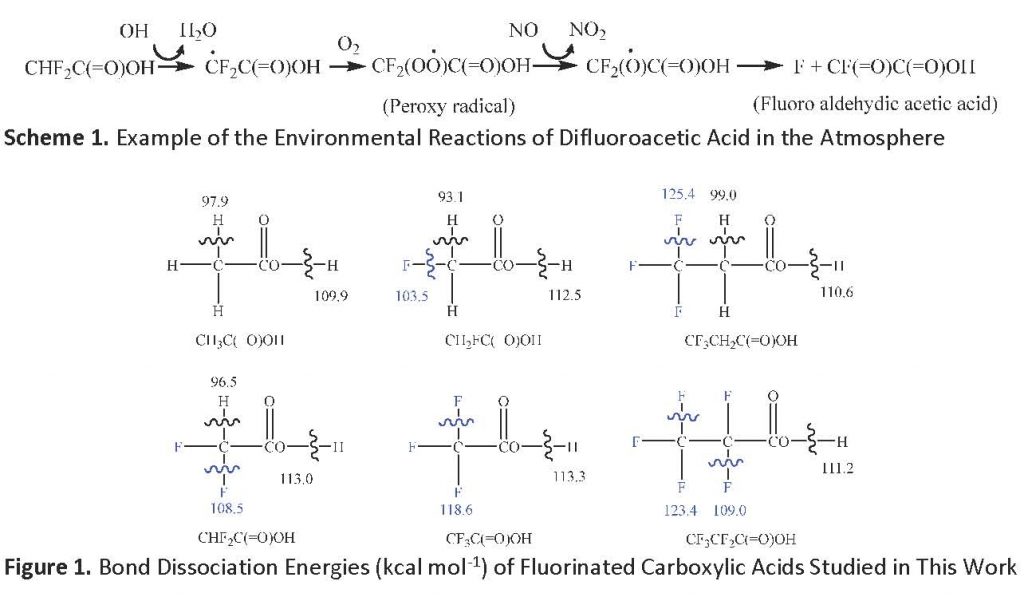
Fluorinated carboxylic acids and their radicals are becoming more prevalent in environmental waters and soils as they have been produced and used for numerous commercial applications. Understanding the thermochemical properties of fluorinated carboxylic acids will provide insights into the stability and reaction paths of these molecules in the environment. Structures and thermodynamic properties for over 50 species related to fluorinated carboxylic acids with two and three carbons are determined using B3LYP, M06-2X, MN15, CBS-QB3, CBS-APNO, and G4 level of theory. Standard enthalpies of formation from CBS-APNO calculations show the smallest standard deviation among methods used in this work. Bond dissociation energies (BDEs) for the carbon−hydrogen, carbon−fluorine, and oxygen−hydrogen (C−H, C−F, and O−H BDEs) in the acids are reported. The C−H, C−F, and O−H bond energies of the fluorinated carboxylic acids are in the range of 89−104, 101−125, and 109−113 kcal mol−1, respectively. General trends show that the O−H bond energies on the acid group increase with the increase in the fluorine substitution. The strong carbon fluorine bonds in a fluorinated acid support the higher stability of the perfluorinated acids in the environment.
Reference: Suarwee Snitsiriwat, Jason M. Hudzik, Kingkan Chaisaward, Loryn R. Stoler, and Joseph W. Bozzelli
J Phys Chem A. 2022, 126, 3−15.
DOI: 10.1021/acs.jpca.1c05484
