Gi–Bbeum Lee,a Eun Jung Han, Dawon Kang, Preeyanuch Junkong and Changwoon Nah
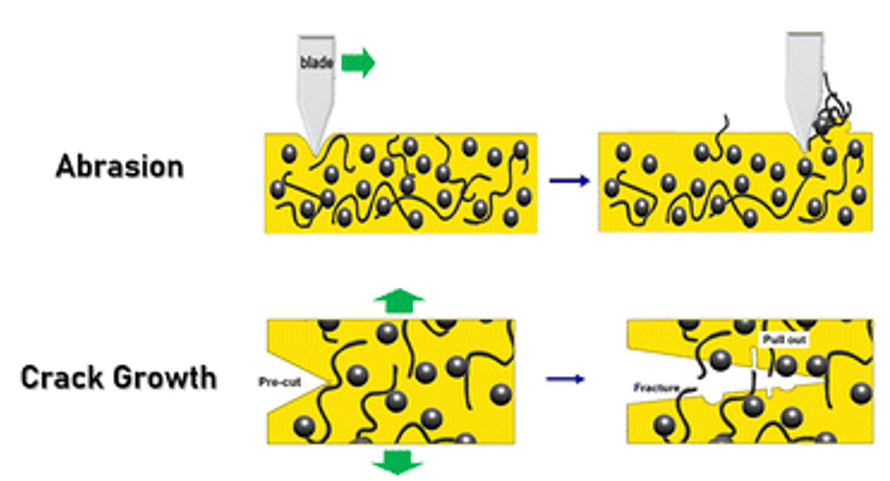
Abrasion and crack growth resistances are critical properties for rubber materials, particularly in tire applications. Styrene-butadiene rubber (SBR) is a widely used synthetic rubber with good abrasion resistance. However, its performance can be further enhanced through the incorporation of reinforcing fillers, especially hybrid filler systems that improve mechanical properties. This study investigates the effects of a hybrid reinforcing system consisting of carbon black and silane-treated carbon nanotubes (T-CNTs) compared with untreated carbon nanotubes (p-CNTs) on the abrasion and fatigue resistance of SBR. Abrasion resistance was evaluated using a blade-type abrader, while fatigue resistance was assessed using a dynamic fatigue instrument. The results show that SBR filled with T-CNTs exhibits superior abrasion resistance compared to SBR filled with p-CNTs and carbon black alone. In the case of untreated CNTs, insufficient interfacial adhesion facilitates their pull-out from the matrix under abrasive action. By contrast, the silane coupling treatment promotes stronger interfacial bonding between the CNT surface and the SBR matrix, thereby improving load transfer efficiency and resistance to material removal during abrasion. In addition, SBR compounds containing T-CNTs or p-CNTs demonstrate improved crack growth resistance compared with carbon black-filled SBR. This behavior is associated with the fibrous morphology and orientation of CNTs, which effectively hinders crack propagation. Additionally, under repeated dynamic straining, gradual and partial pull-out of CNTs contributes to energy dissipation mechanisms that enhance fatigue resistance. Notably, this toughening effect is observed even in the absence of surface modification, although it is more pronounced in the presence of silane treatment due to improved interfacial integrity. These findings demonstrate the potential of silane-treated CNTs in hybrid filler systems to enhance the abrasion and crack growth performance of SBR for advanced rubber applications.
Reference: G. Lee, E. J. Han, D. Kang, P. Junkong and C. Nah, Mater. Adv., 2026, DOI: 10.1039/d5ma01175b.