Dengue fever is a major public health problem in many tropical and subtropical regions, including Southeast Asia, where outbreaks occur regularly and can lead to severe illness or even death. Early diagnosis is essential because timely treatment can reduce complications and improve patient outcomes. One of the most important biomarkers for early dengue infection is the nonstructural protein 1 (NS1), which circulates in the bloodstream during the early stage of infection. Therefore, developing sensitive, rapid, and reliable methods to detect NS1 is crucial for improving dengue diagnosis.
This study presents a new electrochemical sensor designed to detect dengue NS1 using an artificial recognition material instead of natural antibodies. The sensor is based on molecularly imprinted polymer (MIP) nanoparticles, which are synthetic materials engineered to recognize specific molecular targets. In this work, a short fragment of the NS1 protein, called an epitope (Ac-VHTWTEQYKFQ-CONH2), was used as a template to create highly selective binding sites on the polymer nanoparticles. This epitope is conserved among different dengue virus serotypes and is specifically recognized by monoclonal antibody 4F6, which does not cross-react with similar viruses such as Zika virus and Japanese encephalitis virus. This supports the high specificity of the sensor.
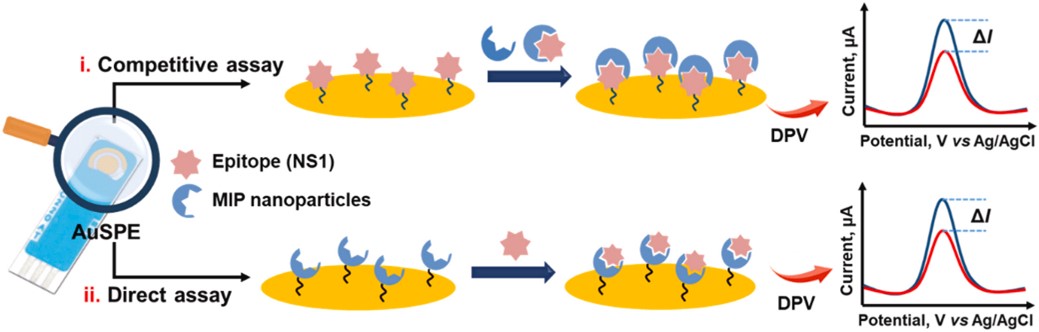
Two detection formats were developed. The first is a competitive assay, where the target protein competes with the epitope attached to the electrode surface for binding to the MIP nanoparticles. The second is a direct assay, where MIP nanoparticles coated on the electrode directly capture the epitope in solution. Both methods demonstrated good sensitivity, with detection limits in the low nanogram per milliliter range, covering clinically relevant NS1 concentrations found in blood during dengue infection.
The sensor also showed good selectivity when tested in human serum samples. Compared with conventional antibody-based methods, this synthetic recognition approach offers advantages such as lower cost, good stability, and reproducibility. This work demonstrates the potential of MIP-based electrochemical sensors as practical tools for early dengue diagnosis and future point-of-care applications.
