Sopinya Nithakorn, Thanthapatra Bunchuay and Preeyanuch Junkong *
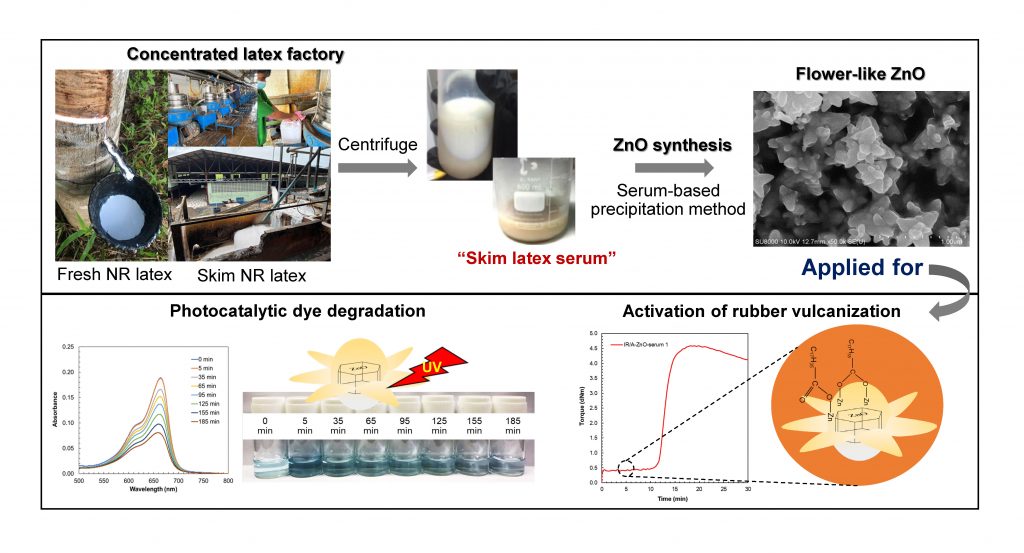
The production of concentrated natural rubber latex generates large volumes of skim latex serum wastewater, which is rich in biomolecules including proteins, carbohydrates, and lipids. In this study, skim latex serum was repurposed as a resource for synthesizing zinc oxide (ZnO) via two approaches: a green synthesis route and a serum-assisted precipitation method. The precipitation method produced a higher yield of ZnO and consistently generated particles with a characteristic flower-like morphology. The particle size of the synthesized ZnO tended to decrease with increasing serum volume, indicating that biomolecules present in the serum play an important role in regulating the nucleation and growth of ZnO. A formation mechanism was proposed, suggesting that these biomolecules function as capping and stabilizing agents throughout the synthesis process. The flower-like ZnO was further evaluated for its photocatalytic performance and its potential use as an activator in sulfur vulcanization. In methylene blue degradation, it followed zero-order kinetics, implying that the photocatalytic activity is strongly related to its specific surface area. Fourier transform infrared spectroscopy confirmed the formation of both syn-syn bridging bidentate and monodentate zinc–stearate coordination at 144 °C, demonstrating its reactivity comparable to commercial ZnO. Additionally, the curing behavior and mechanical properties of rubber vulcanized with the flower-like ZnO closely matched those achieved using commercial ZnO. Overall, this study provides a sustainable pathway for valorizing skim latex serum wastewater through the production of high-performance ZnO, aligning with Sustainable Development Goal 6 and offering benefits for water treatment and rubber manufacturing.