Taweechai Amornsakchai
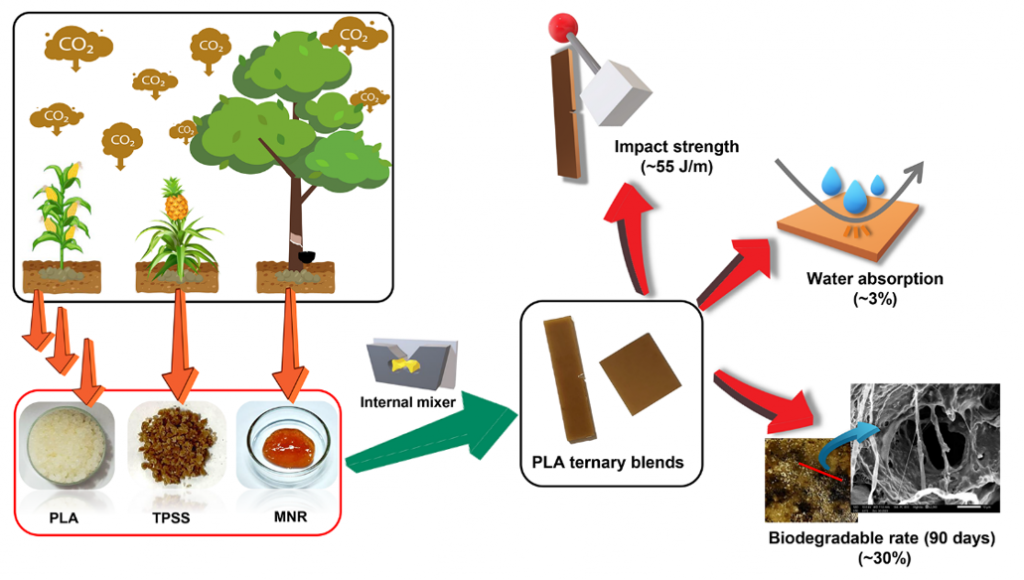
This study addresses challenges faced by poly(lactic acid) (PLA) in the biodegradable plastic market by incorporating thermoplastic pineapple stem starch (TPSS) and modified natural rubber (MNR) into PLA blends. TPSS, derived from pineapple stem waste, enhances hydrophilicity, biodegradability, and reduces costs. While TPSS addition slightly lowered mechanical properties due to poor interaction with PLA, the inclusion of MNR in the PLA/TPSS blend significantly improved stretchability and impact strength. A blend with 7 wt.% MNR showed a 90% increase in impact strength compared to neat PLA. The ternary blend exhibited a heterogeneous morphology with enhanced interfacial adhesion, confirmed by microfibrils and a rough texture on the fracture surface. A downward shift in PLA’s glass transition temperature (Tg) by 5–6 °C indicated improved compatibility. Remarkably, the PLA ternary blends demonstrated superior water resistance and proper biodegradability compared to binary blends. These findings highlight the potential of bio-based plastics, such as PLA blends with TPSS and MNR, to contribute to sustainable economic models and reduce environmental impact in plastic packaging applications.
Reference:
“Sustainable Materials with Improved Biodegradability and Toughness from Blends of Poly(Lactic Acid), Pineapple Stem Starch and Modified Natural Rubber”, Tessanan, W.; Phinyocheep, P.; Amornsakchai, T., Polymers, 2024, 16, 232.