This is a collaboration work with Assoc. Prof. Chularat Sakdaronnarong from Chemical Engineering, Mahidol University. This study investigated how the structure of saccharide-derived carbon dots (CDs) influences their antioxidant performance. Carbon dots are tiny carbon-based nanoparticles that can neutralize harmful free radicals and may be useful in biomedical, food, and environmental applications. However, the relationship between their chemical structure and antioxidant activity has not been fully understood.
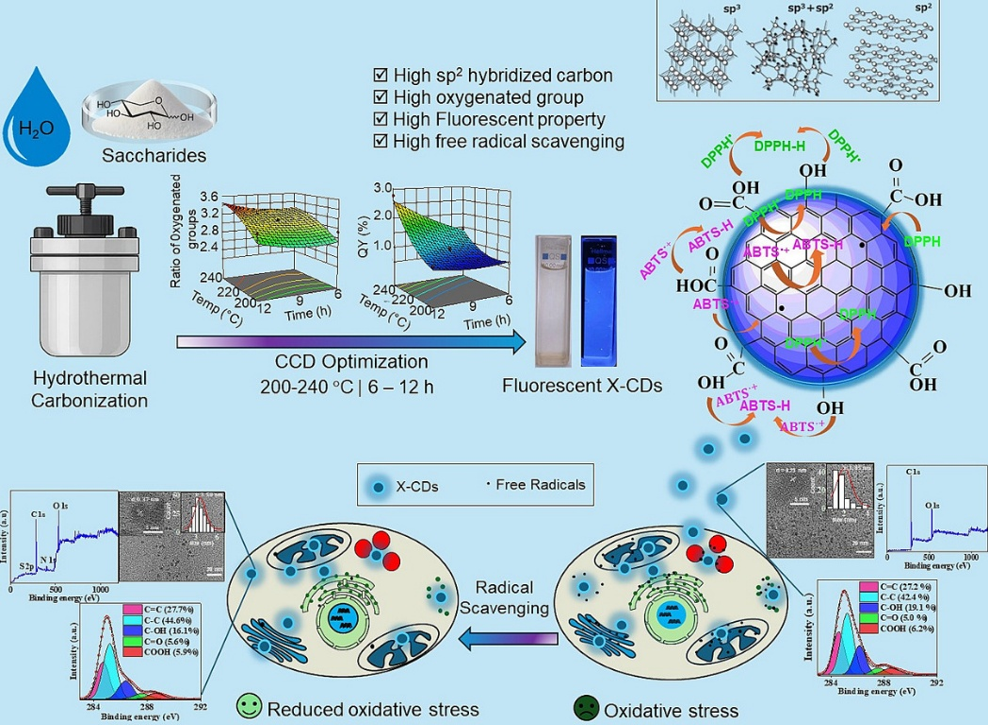
The carbon dots were synthesized from different sugar-based materials, including glucose, fructose, sucrose, cellulose, and xylose, using an environmentally friendly hydrothermal process. The synthesis conditions, especially temperature and reaction time, were optimized to improve the properties of the carbon dots. Among all precursors, xylose produced the best-performing carbon dots (X-CDs). These X-CDs had the smallest particle size, strongest blue fluorescence, highest surface charge, and highest quantum yield. Structural analyses showed that the optimized X-CDs contained abundant oxygen-containing functional groups and highly graphitic sp² carbon domains.
Antioxidant tests using DPPH, ABTS, and ESR measurements demonstrated that the X-CDs could efficiently scavenge free radicals. The antioxidant activity increased as the amount of oxygen functional groups and graphitic sp² domains increased. The study showed that the antioxidant mechanism involves hydrogen donation, electron transfer, and radical adduct formation on the carbon dot surface. Importantly, the optimized X-CDs showed low toxicity toward normal and cancer cells, suggesting good biocompatibility. The results provide a better understanding of how oxygen-containing groups and carbon structure contribute to antioxidant performance and support the development of sustainable, high-performance carbon dots for biomedical, nutraceutical, and environmental applications.
Reference:
Wibowo, A., Khan, M. J., Sawatdee, S., Pornputthapitak, W., Tuntithavornwat, S., Srifa, A., Posoknistakul, P., Pornsuwan, S., Laosiripojana, N., Jiang, Y., Sansanaphongpricha, K., & Sakdaronnarong, C. (2026). Structure–property relationships in saccharide-derived carbon dots: Tuning oxygen functionalities and sp² domains for antioxidant performance. J. Colloid Interface Sci., 710, 139939. https://doi.org/10.1016/j.jcis.2026.139939.
