Jiramet Mekarun a, Thammika Srisaman b, Anyarat Watthanaphanit a,b,*
a Department of Chemistry, Faculty of Science, Mahidol University, Salaya, Nakhon Pathom, 73170, Thailand
b School of Materials Science and Innovation, Faculty of Science, Mahidol University, Salaya, Nakhon Pathom, 73170, Thailand
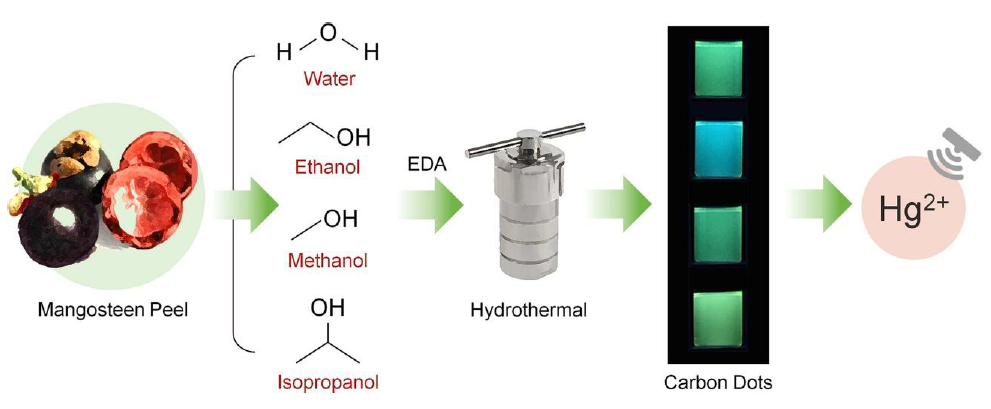
Heavy metal contamination remains a critical threat to global health and the environment, requiring smarter, more sustainable detection methods. In this study, our researchers successfully developed an eco-friendly approach to produce nitrogen-doped carbon dots (CDs) by upcycling mangosteen peel extract, a common agricultural waste. Using a simple “one-pot” heating method, we explored how different solvents—water, ethanol, methanol, and isopropanol—influence the properties of these nanomaterials. The results are visually striking: by simply changing the solvent, the carbon dots’ glow (fluorescence) can be tuned from vibrant blue to greenish-yellow. Beyond their aesthetic appeal, these tiny particles serve as highly effective sensors for mercury (Hg2+). When mercury is present, it triggers a “fluorescence quenching” effect, essentially turning off the particles’ glow. This sensor demonstrated high precision and was successfully validated using real wastewater samples, proving its potential as a low-cost, equipment-free tool for environmental monitoring. This work not only provides a strategy for waste valorization but also paves the way for advanced, bio-based sensing platforms in line with global sustainability goals.
Reference: Solvent-controlled synthesis of nitrogen-doped carbon dots from mangosteen peel extract and application in the detection of mercury ions. Jiramet Mekarun, Thammika Srisaman, Anyarat Watthanaphanit*. Resour. Chem. Mater. 2026, 100153. https://doi.org/10.1016/j.recm.2025.100153
