Harit Chunlim, Manopat Depijan, Kasempong Srisawad, Tanawut Meekati, Duangmanee Wongratanaphisan, Pipat Ruankham, Pongsakorn Kanjanaboos, Pasit Pakawatpanurut
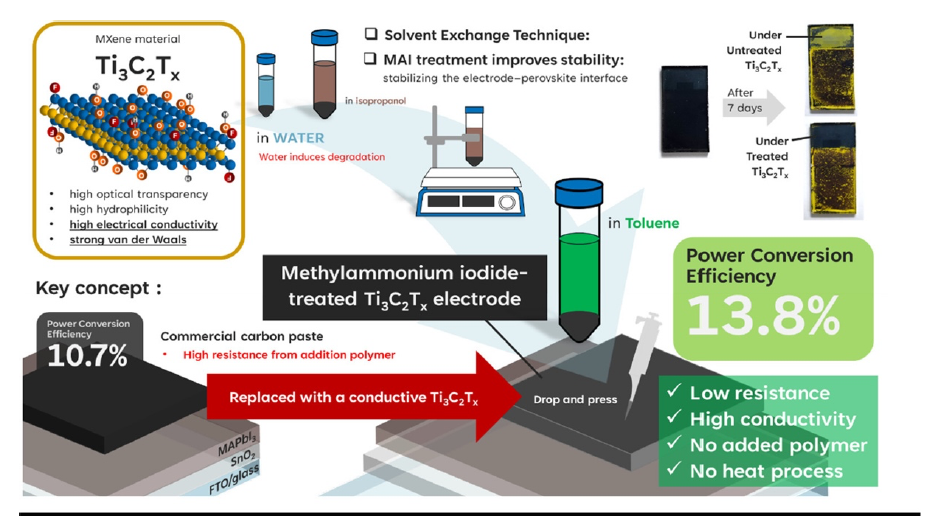
Scientists are working to nake perovskite solar cells—a pronusing new type of solar technology—- cheaper and more efficient. A common way to make them affordable is to use a carbon-based electrode to collect the electicity. However. these carbon electrodes are like a paste made of conductive particles mixed with an insulating ” “ghe” (a polymer binder). This glue holds everything together but slows down the flow of electricity, which linits the solar cell’s overall performance. This research team tried a new approach. they used a hishly conductive, 2D material called MXene (specifically TbCoL_) as the electrodecause it’s a continous, conductive sheet, it doesn’t need any insulating glue. However, they discovered a major problen: when the bare MXene was placed directly onto the light-absorbing perovskite layer, chemically reacted with it, destroying the solar cell almost instantly. So, they developed a clever solution. Before applying the MXene, they gave it a special chemical treatment using a substance called methylammonionium iodide (MAI). This treatment created a protective,” “passive” layer on the MXene’s surface. This new, treated MXene was no longer. The resubing solar cell was not only stable but also highly efficient, achieving 13.8% efficiency-significantly better than the 10.796 of the standarbon electrode. The improved electical flow also meant it performed much better when scaled up to larger sizes.Reference:
Chunlim H, Depijan M, Srisawad K, Meekati T, Wongratanaphisan D, Ruankham P, Kanjanaboos P, Pakawatpanurut P. Solution-processed, binder-free pristine Ti3C2Tx MXene electrodes enabled by MAI passivation for highperformance, scalable perovskite solar cells. Appl Surf Sci Adv. 2025;28:100803-16. DOI: 10.1016/j.apsadv.2025.100803