Jianfeng Zhang, Narisara Tanjedrew, Marco Wenzel, Philipp Royla, Hao Du, Supavadee Kiatisevi, Leonard F. Lindoy, and Jan J. Weigand*
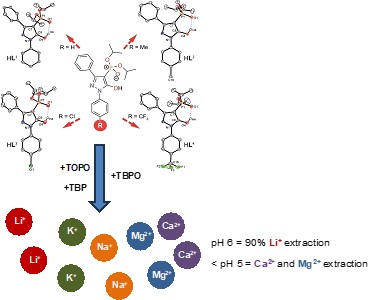
To ensure a continuous and sustainable supply of lithium, it is essential to develop highly efficient separation processes such as liquid-liquid extraction (LLE), applicable to both primary sources and certain waste streams. In this study, we employed 4-phosphoryl pyrazolones in the presence of different organophosphorus co-ligands including tributylphoshine oxide (TBPO), tributylphosphate (TBP), and trioctylphosphine oxide (TOPO) in a pH-controlled, stepwise separation process to efficiently separate Li+ Ca2+, Mg2+, Na+ and K+ ions. We systematically examined the factors affecting the LLE process, including the substitution pattern of the extractant, diluent/water distribution, pH levels and the speciation of the metal complexes involved. Our findings revealed a maximum extraction efficiency for Li⁺ of 94% at pH 6.0, achieved following the prior separation of Mg²⁺ and Ca²⁺ at pH values below 5.0. This demonstrates that the separation of these ions can be effectively managed by modulating the pH of the aqueous phase.
Reference:
Zhang, J.; Tanjedrew, N.; Wenzel, M.; Royla, P.; Du, H.; Kiatisevi, S.; Lindoy, L. F.; Weigand, J. J., Selective Separation of Lithium, Magnesium and Calcium using 4‐Phosphoryl Pyrazolones as pH‐Regulated Receptors. Angew. Chem. Int. Ed., 2023, 62, e202216011.
DOI: 10.1002/anie.202216011
