Pitiphoom Sangiamkittikul,a Sopon Nuchpun,b Kanlaya Prapainop Katewongsa,b Tawinan Cheiwchanchamnangij,c Korawit Khamphaijun,a Thanthapatra Bunchuay,a Nattapon Panupinthu,d,e Worakrit Saiyasombat,f Sitthivut Charoensutthivarakul,g Supavadee Kiatisevi a*
aDepartment of Chemistry and Center of Excellence for Innovation in Chemistry (PERCH-CIC), Faculty of Science, Mahidol University, Bangkok, Thailand. Email: supavadee.mon@mahidol.ac.th
bDepartment of Biochemistry, Faculty of Science, Mahidol University, Bangkok, Thailand
cDepartment of Physics, Faculty of Science, Mahidol University, Bangkok, Thailand
dCenter of Calcium and Bone Research (COCAB), Faculty of Science, Mahidol University, Bangkok, Thailand
eDepartment of Physiology, Faculty of Science, Mahidol University, Bangkok, Thailand f. Institute of Nutrition, Mahidol University, Nakhon Pathom, Thailand
gSchool of Bioinnovation and Bio-Based Product Intelligence, Faculty of Science, Mahidol University, Bangkok, Thailand
This study introduces a novel supramolecular photosensitizer, PS3⸦WP5, formed by the host–guest complexation of a mannosylated pillar[5]arene (WP5) and a near-infrared BODIPY photosensitizer (PS3). The complex exhibits strong binding affinity (Ka = 5.10 × 10⁶ M–¹) and self-assembles into nanoparticles in aqueous solution. Upon 633 nm light irradiation, PS3⸦WP5 demonstrates high singlet oxygen generation efficiency (ɸΔ= 0.95) and excellent photostability. In vitro experiments confirm its superior photodynamic therapy (PDT) efficacy, good biocompatibility, and low dark toxicity compared to free PS3, which suffers from poor aqueous solubility and limited cellular uptake. This supramolecular approach offers a promising strategy for designing multifunctional nanomaterials for cancer phototherapy, potentially overcoming the limitations of conventional photosensitizers.
งานวิจัยนี้นำเสนอสารไวแสง (photosensitizer) แบบซุปราโมเลกุล (Supramolecular) ชนิดใหม่ PS3⸦WP5 ซึ่งเกิดจากการสร้างคอมเพล็กซ์ระหว่างพิลลารีนที่มีหมู่แมนนอสมาต่อ (mannosylated pillar[5]arene, WP5) และสารสารไวแสง BODIPY ที่ดูดกลืนแสงใกล้อินฟราเรด (PS3) คอมเพล็กซ์นี้มีความสามารถในการจับกันอย่างแข็งแรง (Ka = 5.10 × 10⁶ M-¹) และสามารถรวมตัวกันเป็นอนุภาคนาโนในน้ำได้เองซึ่งเมื่อได้รับการฉายแสงที่ความยาวคลื่น 633 นาโนเมตร PS3⸦WP5 แสดงประสิทธิภาพในการสร้างซิงเกิลออกซิเจนสูง (ɸΔ= 0.95) และมีความเสถียรต่อแสงที่ดีเยี่ยม การทดลองในหลอดทดลองยืนยันว่า PS3⸦WP5 มีประสิทธิภาพในการบำบัดด้วยแสง (PDT) ที่เหนือกว่า มีความเข้ากันได้ทางชีวภาพที่ดี และมีความเป็นพิษในที่มืดต่ำ เมื่อเทียบกับ PS3 ที่มีปัญหาเรื่องการละลายน้ำและการดูดซึมเข้าสู่เซลล์ที่จำกัด แนวทางซุปราโมเลกุล นี้จึงเป็นกลยุทธ์ที่มีศักยภาพในการออกแบบวัสดุนาโนมัลติโฟกชันสำหรับการรักษามะเร็งด้วยแสง
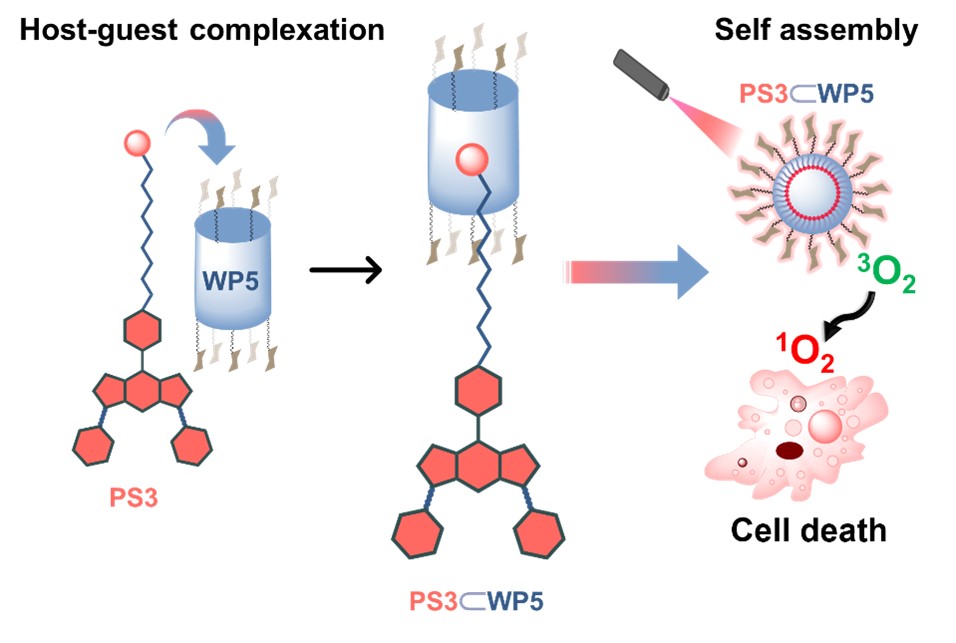
Reference: Sangiamkittikul, P.; Nuchpun, S.; Katewongsa, K. P.; Cheiwchanchamnangij, T.; Khamphaijun, K.; Bunchuay, T.; Panupinthu, N.; Saiyasombat, W.; Charoensutthivarakul, S.; Kiatisevi, S. Potent Mannose-Modified Pillararene-BODIPY System for Photodynamic Therapy.
J. Mater. Chem. B, 2025, Accepted Manuscript.
