OnUma Kheowan, Walaipan Maneedul, Wannabhorn Motina, Thanthapatra Bunchuay, and Soraya Pornsuwan
Chemical Physics Letters (2026), 882, 142490.
This study investigated how light affects an uncatalyzed Belousov–Zhabotinsky (BZ) chemical oscillator based on 1,4-cyclohexanedione (CHD) and bromate ions. It was aimed to understand whether free radicals are involved in the light response of the system and used Electron Spin Resonance (ESR) spin trapping with DMPO to detect these short-lived radical species.
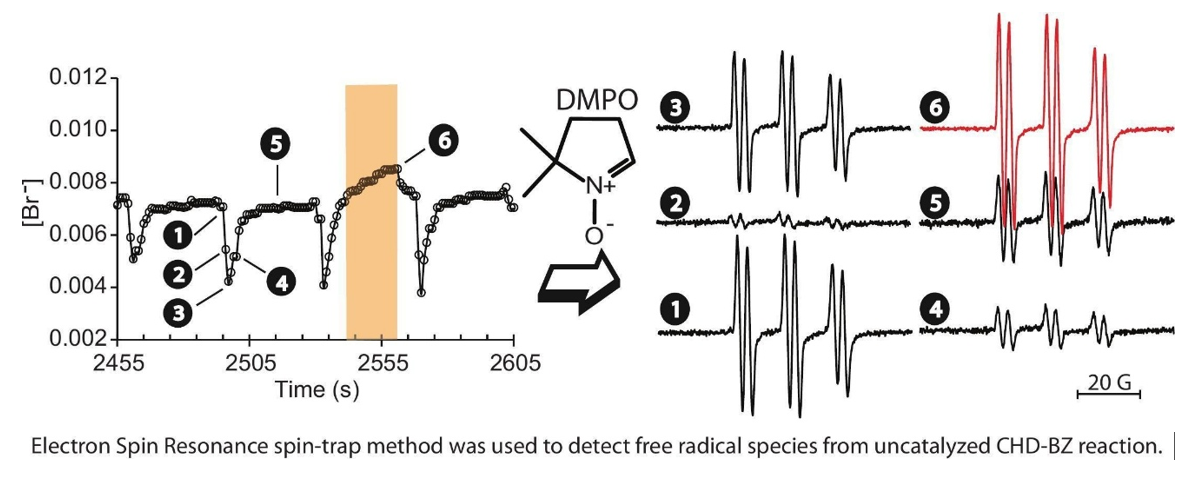
The results showed that the CHD–bromate BZ reaction is sensitive to visible light even without a metal catalyst. When the reaction mixture was briefly illuminated, the bromide ion concentration increased and the ESR signal intensity became about three times stronger. This indicates that light enhances the formation of radical intermediates during the oscillatory reaction.
ESR measurements revealed unusual nitroxide spin-adduct patterns consistent with structural rearrangement of the DMPO spin trap under strongly acidic conditions. The ESR signal changed during different phases of the oscillation cycle and correlated with bromide concentration, suggesting that radical formation is closely linked to the oscillatory mechanism.
Overall, the study provides evidence that free radicals, likely involving bromine dioxide and semiquinone species, play an important role in the photosensitivity of the uncatalyzed CHD–BZ reaction. These findings improve understanding of light-responsive chemical oscillators and may help develop future applications in smart photoresponsive materials, sensing systems, and chemically inspired information-processing technologies.