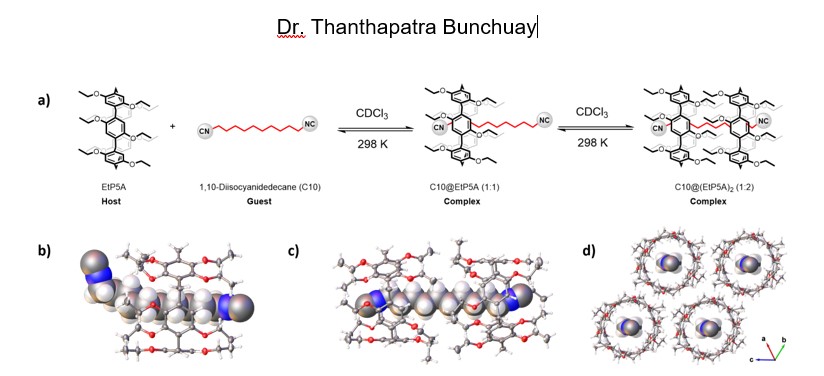
Pillar[n]arenes have attracted considerable attention in the construction of mechanically interlocked molecules due to their facile synthesis, unique highly symmetrical shape, and versatile functionalities. Their structure, consisting of a π-electron-rich cavity and crown ether-like arrangement of oxygen atoms at both apertures, make them ideal candidates as host molecules for various electron-deficient guests. In recent years, a range of neutral and cationic molecules have demonstrated the capability to form pillararene-based [2]pseudorotaxanes, wherein interactions such as C-H···π, cation···π, or both, serve as the principal driving forces for interpenetrated complex self-assembly. However, only a handful of pillararene-based [3]pseudorotaxanes have been reported, mostly from cationic guest templates, including quaternary ammonium salts, pyridinium derivatives and bis(imidazolium) alkyl chains. Conceivably however, the application of neutral guest molecules to achieve the template directed assembly of higher order pillararene structures is more challenging, due to weaker intermolecular interactions relative to positively charged counterparts. In addition, the binding affinity of pillararene towards these guests is significantly attenuated by solvent polarity, typically restricting pseudorotaxane formation to low polarity organic solvent. To date, alkyl cyanides are reported to exhibit some of the largest binding affinities for pillararene cavities, and have therefore featured heavily in pillararene-based supramolecular assembly. Whilst a wealth of cyanide complexes have been reported, pillararene’s interaction with isocyanides remains unexplored. This is especially surprising given that isocyanides exhibit many useful applications including metal coordination and serve as important precursors in multicomponent reactions such as the Ugi and Passerini. Herein, we report the formation of pseudorotaxane complexes between a pillar[5]arene and various isocyanide guests. Using 1H-NMR spectroscopic techniques to investigate their host-guest binding behaviour, our results demonstrate that diisocyanide guest molecules afford remarkably stable complexes with pillar[5]arene. Unprecedentedly, by only lengthening the -CH2 units in a homologous series of alkyl diisocyanides it is possible to switch between [2]- and [3]pseudorotaxane assemblies (Fig.1), which is confirmed by extensive 1H-NMR spectroscopic studies and X-ray crystallographic analysis.
Reference
Chem. Commun., 2022,58, 7253-7256 (https://pubs.rsc.org/en/content/articlelanding/2022/cc/d2cc02255a)
