Dini Rohmawati,a,b Chayut Thongdeelert,a Tienthong Thongpanchanga
aDepartment of Chemistry and Center of Excellence for Innovation in Chemistry (PERCH-CIC), Faculty of Science, Mahidol University, Bangkok 10400, Thailand.
bDepartment of Chemistry Education, Faculty of Mathematics and Science, Universitas Negeri Yogyakarta, Yogyakarta 55281, Indonesia
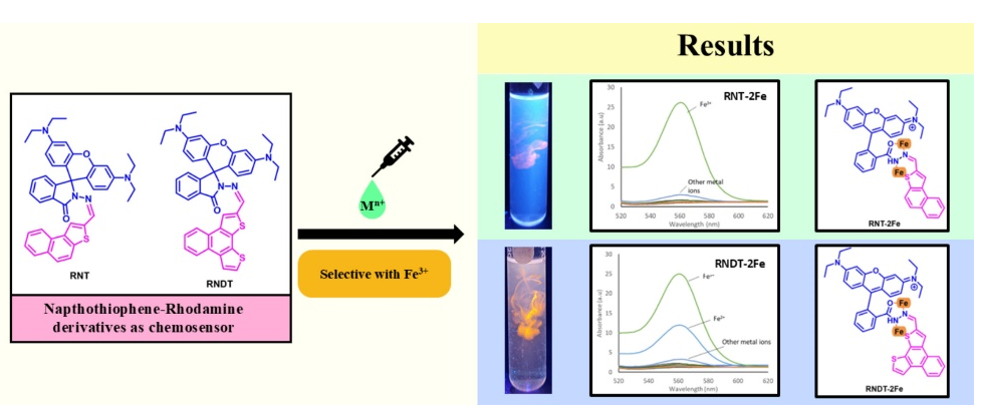
Naphthothiophene derivatives are often used as components in electronic materials. In this study they were tested as a part of sensors for detecting Fe3+ ions. Two sensor molecules were created by linking naphthothiophene to a fluorescent dye called rhodamine. These sensors were studied in a mixture of methanol and water at neutral pH. When Fe3+ ions were added, the sensors reacted quickly and much more strongly than they did with other metal ions. The solution changed color from colorless to pink-orange, and the fluorescence became much brighter within seconds. One sensor became about 70 times brighter, while the other increased about 11 times. The sensors were very sensitive and could detect extremely small amounts of Fe3+. This response happens because Fe3+ ions bind to certain parts of the sensor molecule, causing a structural change that turns on the fluorescence. When too much Fe3+ was added, the fluorescence decreased again, showing that a different type of Fe3+–sensor complex had formed. Both sensors were found to bind Fe3+ in a 1:2 ratio, which was confirmed using data analysis and mass spectrometry. Overall, these results show that the sensors provide a fast, sensitive, and selective way to detect iron ions.
Rohmawati, D.; Thongdeelert, C.; Thongpanchang, T. Results Chem. 2025, 16, 102530.
