Khemchart Yuwananonta,a Rungthip Kunthom,b,c,* Pawares Pornchaiprasartkul,a Siraprapa Somsri,a Thanthapatra Bunchuay,a Yuwanda Injongkol,b,c Khamphee Phomphrai,d Sareeya Bureekaew,e Bunyarat Rungtaweevoranit,f Preeyanuch Sangtrirutnugula,*
aCenter of Excellence for Innovation in Chemistry (PERCH−CIC), Department of Chemistry, Faculty of Science, Mahidol University, Bangkok 10400, Thailand
bFuturistic Science Research Center, School of Science, Walailak University, Nakhon Si Thammarat 80160, Thailand
cFunctional Materials and Nanotechnology Center of Excellence, Walailak University, Thasala, Nakhon Si Thammarat 80160, Thailand
dSchool of Molecular Science and Engineering (MSE), Vidyasirimedhi Institute of Science and Technology (VISTEC), Wangchan Valley, Rayong 21210, Thailand
eSchool of Energy Science and Engineering (ESE), Vidyasirimedhi Institute of Science and Technology (VISTEC), Wangchan Valley, Rayong 21210, Thailand
fNational Nanotechnology Center (NANOTEC), National Science and Technology Development Agency (NSTDA), Pathum Thani, 12120, Thailand.
Corresponding Author Emails: preeyanuch.san@mahidol.edu (P. Sangtrirutnugul) and rungthip.kunthom@gmail.com (R. Kunthom)
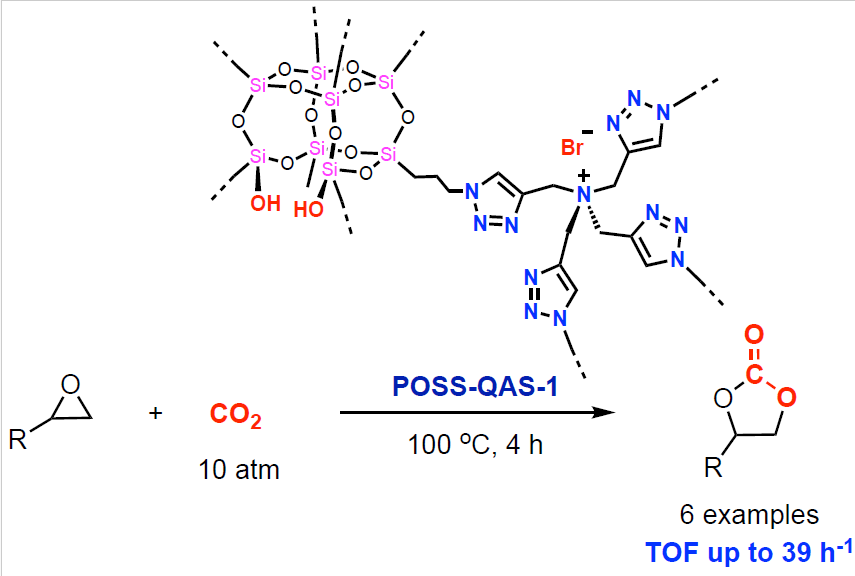
This study developed a new metal-free, reusable catalyst that converts carbon dioxide (CO2) into valuable cyclic carbonates, which are important chemicals used in solvents, batteries, and polymer production. Two crosslinked polymers based on polyhedral oligomeric silsesquioxane (POSS), which are an ionic material (POSS-QAS-1) containing quaternary ammonium iodide groups and a neutral analogue with tertiary amine (POSS-triprop), were successfully synthesized.
In comparison, POSS-QAS-1 showed outstanding catalytic performance for the reaction between CO2 and epoxides without requiring solvents, metal additives, or cocatalysts. Under efficient conditions (100 °C, 10 atm CO2), the ionic polymer catalyst afforded 91% conversion of epichlorohydrin with >99% selectivity to the cyclic carbonate product (TOF = 39 h-1). The catalyst could be reused for at least four cycles with minimal loss of activity.
Experimental and computational studies revealed that the catalyst works through a cooperative mechanism: silanol groups on the POSS framework activate the epoxide, while iodide ions promote ring opening and subsequent CO2 incorporation. This work demonstrates that ionic POSS-based polymers are promising sustainable catalysts for CO2 utilization, combining high activity, recyclability, and the elimination of metal-based components.