Naphol Witayapaisitsan†, Thanapat Worakul†, and Panida Surawatanawong*,†,‡
†Department of Chemistry and Center of Excellence for Innovation in Chemistry, Faculty of Science, Mahidol University, Bangkok 10400, Thailand
‡Center of Sustainable Energy and Green Materials, Mahidol University, Salaya, Nakhon Pathom 73170, Thailand
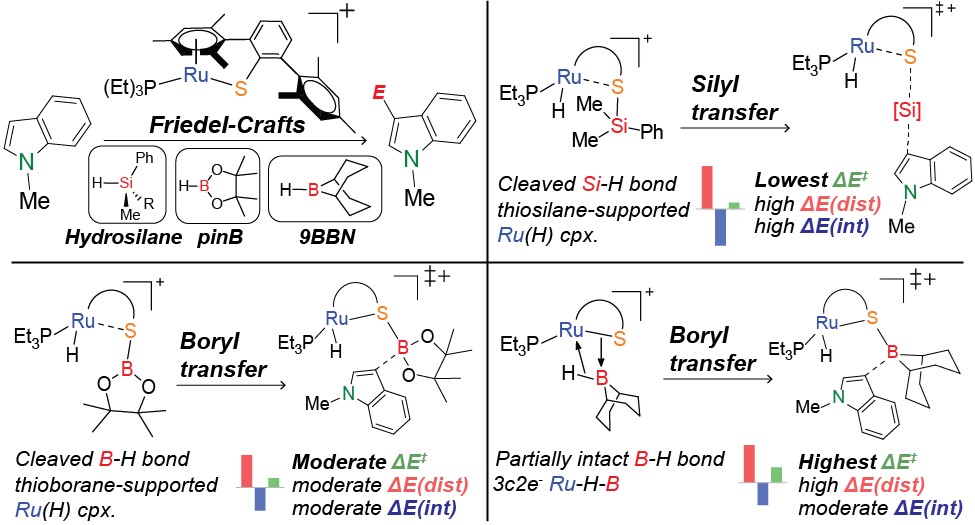
The silylation and borylation of N-heteroarenes are essential processes for preparing key building blocks in organic synthesis. The Ru-S complex 1, [(PEt3)Ru(DmpS)]+ (DmpS = 2,6-dimesitylphenyl thiolate), catalyzes both C-H silylation and borylation of N-heteroarenes. Herein, we performed a density functional study to investigate the mechanisms of 1 catalyzed C–H silylation of 1-methylindole using hydrosilanes and C–H borylation using dialkoxyhydroborane (HBpin) and dialkylhydroborane (9BBN). The mechanism involves four main steps: (i) Si–H/B–H activation, (ii) silyl/boryl transfer to 1-methylindole, (iii) proton abstraction to yield the silylated/borylated product, and (iv) H2 elimination to regenerate complex 1. The rate determining step is silyl/boryl transfer. Notably, upon the B–H activation, the B–H bond of HBpin is fully cleaved while the B–H bond of 9BBN remains partially intact. Moreover, instead of forming silylium/borenium ions, the Si–H and B–H activations lead to distinct Si–H/B–H activated complexes: (i) thiosilane/thioborane-supported Ru-H complexes for hydrosilane and HBpin, and (ii) a three-center two-electron Ru-H-B complex for 9BBN. Differences in bonding interactions affect the energy barriers in the silyl/boryl transfer. Insights into these electronic structures provide a foundation for designing metal-ligand cooperative catalysts for C–H silylation and borylation of N-heteroarenes.
Reference: Witayapaisitsan, N.; Worakul, T.; Surawatanawong,* P. Inorganic Chemistry 2025, 64, 4090-4102.
