Jonas Börgel, Nicole Removski, Jordan W. Taylor, Zikri Hasanbasri, Khetpakorn Chakarawet, Alexander J. Heyer, Patrick W. Smith, N. Isaac Zakaria, Danh X. Ngo, Ryan A. Klein, Maria V. Paley, Vincent R. Allen, Chaochao Dun, Henry Z. H. Jiang, Nykita Z. Rustad, Tieyan Chang, Ying-Pin Chen, Mauricio Lopez Luna, Wanli Yang, Brandon R. Barnett, Jeffrey A. Reimer, Yu-Sheng Chen, Jeffrey J. Urban, Monika Blum, Stefan G. Minasian, Edward I. Solomon, R. David Britt, T. David Harris, Jeffrey R. Long*
J. Am. Chem. Soc. 2026, 148(1), 837–846.
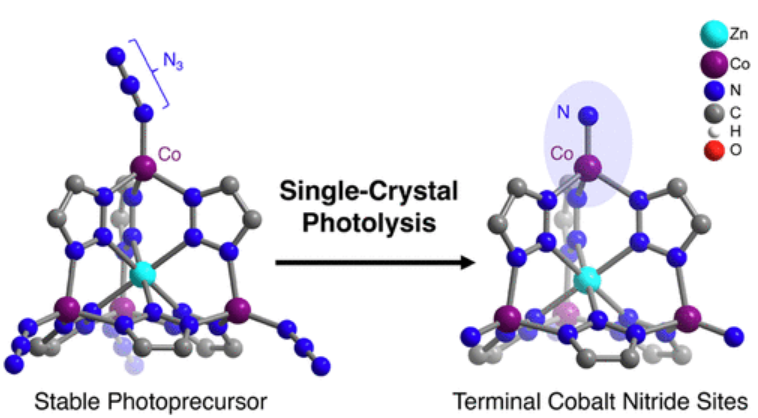
This work presents the first successful isolation and direct observation of a terminal cobalt nitride, a very reactive chemical species, by trapping it inside the nanopores of a specially designed metal–organic framework (MOF). Normally, metal nitride intermediates are so reactive that they quickly fall apart in solution and are extremely hard to study, but the rigid, empty pores of the MOF keep them stable long enough for isolation. By either heating or shining light on a cobalt-azide precursor inside the framework, cobalt nitride was formed and confirmed by X-ray crystallography and several spectroscopic techniques. This nitride can react with other molecules, suggesting new possibilities for understanding and using reactive metal–nitrogen species in catalysis and materials science.