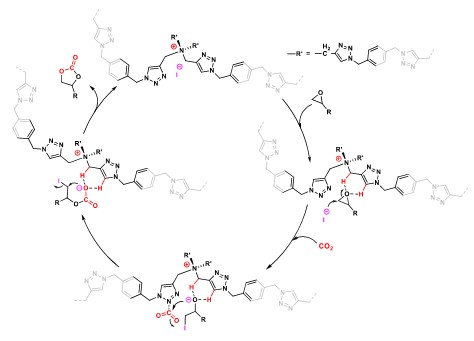
The research work explores innovative polymers called ionic quaternary ammonium-triazole polymers (QAPs), which act as single-component catalysts for converting carbon dioxide (CO2) into cyclic carbonates. These carbonates are valuable precursors for the production of plastics and batteries. Our research group synthesized three versions of these polymers (QAP1, QAP2, QAP3) and tested their efficiency. Among the three, QAP1 showed the best performance, achieving high conversion rates at 10 atm CO2, 120 °C. It is also reusable up to four cycles with minimal efficiency loss. However, some thermal degradation was observed over time, which reduced its durability.
The study highlights the polymers’ advantages: they simplify catalytic systems and reduce chemical wastes by integrating essential components and consequently eliminating the need for additional co-catalysts. We also proposed a mechanism explaining how QAPs facilitate CO2 conversion, using their structure to activate and transform the molecules. While promising, the polymers’ lower CO2 absorption compared to similar materials suggests room for improvement, particularly in increasing thermal stability and efficiency.
This research contributes to sustainable carbon capture and utilization, potentially lowering environmental impact through innovative chemistry.