Ponsiri Liangsakul,1,2 Chutima Kuhakarn,1 Siriporn Jungsuttiwong,3 Ratchadaree Intayot,3 Sariyarach Thanasansurapong,1 Radeekorn Akkarawongsapat,4 Arthit Chairoungdua,5 Narong Nuntasaen,6 Sakchai Hongthong,7,* Vichai Reutrakul1,*
1Department of Chemistry, and Center of Excellence for Innovation in Chemistry (PERCH-CIC), Faculty of Science, Mahidol University, Bangkok, Thailand
2Department of Agronomy, Faculty of Agriculture at Kamphaeng Saen, Kasetsart University, Kamphaeng Saen Campus, Nakhon Pathom, Thailand
3Department of Chemistry and Center of Excellence for Innovation in Chemistry, Faculty of Science, Ubon Ratchathani University, Ubon Ratchathani, Thailand
4Department of Microbiology, Faculty of Science, Mahidol University, Bangkok, Thailand
5Department of Physiology, Faculty of Science, Mahidol University, Bangkok, Thailand
6The Forest Herbarium National Park, Wildlife and Plant Conservation Department, Ministry of Natural Resources and Environment
7Division of Chemistry, Faculty of Science and Technology, Rajabhat Rajanagarindra University, Chachoengsao, Thailand
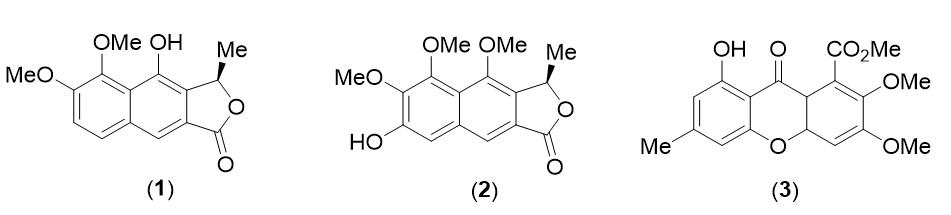
Three new compounds, including two fused tricyclic naphthalene lactones, namely ventilaganones A and B, and a xanthone, namely ventilagoxanthone, along with eight known compounds (8-dihydroxy-6-methyl-9-oxo-9H-xanthene-1-carboxylate, conioxanthone A, chrysophanol, physcion, emodin, ventilanone K, 2-hydroxyemodin 1-methyl ether, and questin) were isolated from the bark of Ventilago maingayi. Their structures were elucidated by extensive analysis of their spectroscopic data and by comparison with those of related compounds reported in the literature. The absolute configuration of ventilaganone A was established by single crystal X-ray analysis. Anti-HIV-1 activity of the isolated compounds was evaluated with a reverse transcriptase (RT) assay and a syncytium reduction assay using the ΔTat/RevMC99 virus in 1A2 cell line.