Attawit Jehdaramarn, Teera Chantarojsiri, Thanapat Worakul, Panida Surawatanawong, Kittipong Chainok & Preeyanuch Sangtrirutnugul*
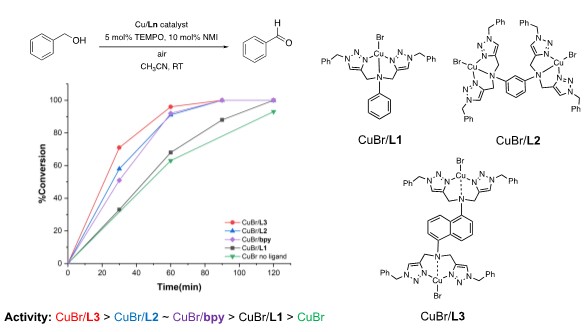
Cu-catalyzed aerobic alcohol oxidation has recently emerged as a promising and eco-friendly method to convert alcohols into aldehydes. In nature, enzymes containing multiple copper active sites are highly active towards oxidation due to their ability to efficiently transfer multiple electrons. To mimic these enzymes and understand how ligands enhance the catalytic oxidation activities, a class of mononuclear copper catalyst CuBr/L1 and multinuclear copper catalysts linked by two different ligand linkers, i.e., 1,3-phenylene (L2) and 1,5-naphthalene (L3), were prepared. We observed higher catalytic oxidation activities of CuBr/L3 compared to other copper catalysts. Electrochemical data reveal that the enhanced catalytic performance of CuBr/L3 is attributed to the presence of less stable, mixed-valence and more reducible Cu(I)‐L3‐Cu(II) intermediates, compared to Cu(I)‐L2‐Cu(II). Additionally, the catalyst system, CuBr/L3 with the TEMPO co-catalyst and N-methylimidazole base, efficiently promotes the aerobic oxidation of benzyl alcohol to benzaldehyde at room temperature in CH3CN with a high turnover frequency (TOF) of 38 h−1 at 1 h.