This is a collaboration work with Assoc. Prof. Weerachai Singhatanadgit at the Faculty of Dentistry and Research Unit in Mineralized Tissue Reconstruction, Thammasat University. This study developed a dual-functional biodegradable drug delivery system designed to help prevent medication-related osteonecrosis of the jaw associated with bisphosphonate treatment (MRONJ-B), a serious condition that can occur in patients receiving drugs such as zoledronic acid (ZA) for osteoporosis or cancer treatment. MRONJ-B can cause painful jawbone damage, poor wound healing, and bacterial infection after dental procedures.
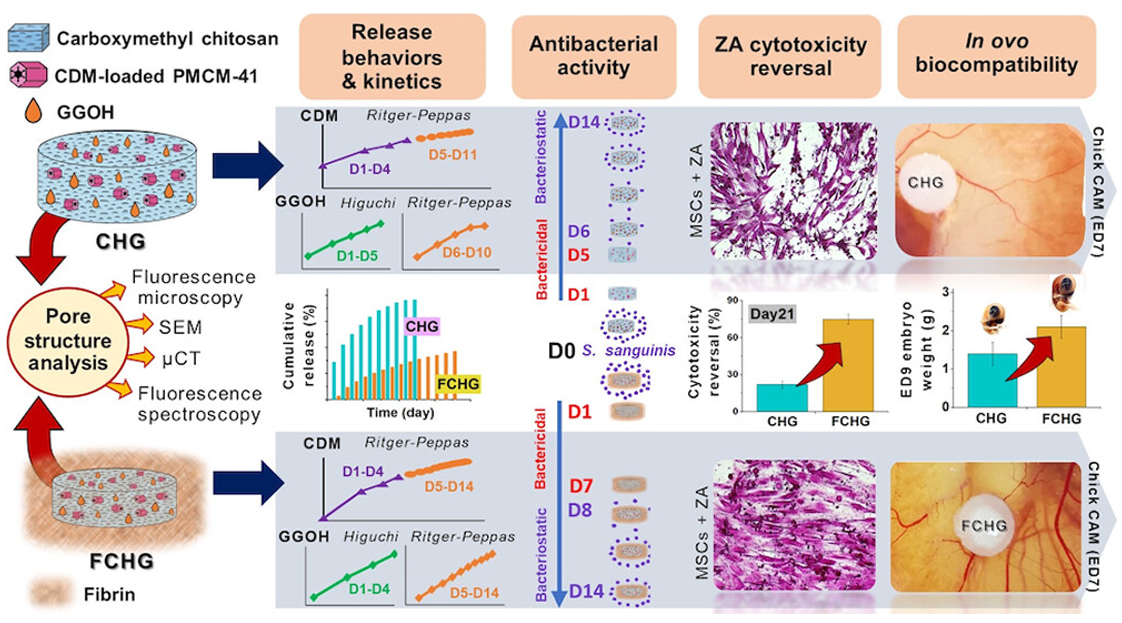
The authors created composite hydrogels using carboxymethyl chitosan and plasma-treated mesoporous silica nanoparticles (MCM-41). These hydrogels were designed to simultaneously deliver two therapeutic agents: clindamycin (CDM), an antibiotic that kills oral bacteria, and geranylgeraniol (GGOH), a compound that can reduce the toxic effects of ZA on bone-related cells. To better imitate real biological conditions, some hydrogels were additionally embedded inside a human-derived fibrin gel, which mimics the blood clot naturally formed around implanted materials after surgery. The study showed that fibrin significantly affected the release behavior of both drugs, slowing their release and prolonging their activity. Microscopy and μCT imaging demonstrated that the hydrogels had highly interconnected porous structures that allowed fibrin fibers to penetrate into the hydrogel pores. The fibrin-containing hydrogels had lower porosity but still maintained high pore interconnectivity, which is important for nutrient transport and tissue healing.
Drug-release studies showed that both CDM and GGOH were released gradually over extended periods. In simulated interstitial fluid, the release lasted longer than in conventional phosphate buffer solution. When fibrin was added, the release became even slower and more sustained, extending for at least 14 days while greatly reducing the initial burst release of both drugs.
The hydrogels exhibited strong antibacterial activity against Streptococcus sanguinis, a bacterium associated with MRONJ infections. In addition, the released GGOH helped protect mesenchymal stem cells from ZA-induced toxicity while preserving their ability to differentiate into bone-forming cells. Importantly, the fibrin-containing hydrogels also reduced acute toxicity in both cell-based and chick embryo models, suggesting improved biocompatibility and safety.
Overall, this work presents a promising local drug-delivery platform that combines antibacterial treatment with protection against bisphosphonate toxicity. The findings also emphasize the importance of using biologically realistic models, such as fibrin-containing matrices, when evaluating implantable drug delivery systems.
Reference:
Sungkhaphan, P., Thavornyutikarn, B., Muangsanit, P., Kaewkong, P., Kitpakornsanti, S., Pornsuwan, S., Singhatanadgit, W., & Janvikul, W. (2023). Dual-functional drug delivery system for bisphosphonate-related osteonecrosis prevention and its bioinspired releasing model and in vitro assessment. ACS Omega. https://doi.org/10.1021/acsomega.3c03440.
