This is a collaboration work with Assoc. Prof. Weerachai Singhatanadgit at the Faculty of Dentistry and Research Unit in Mineralized Tissue Reconstruction, Thammasat University. This study developed a dual-functional nanomaterial designed to help prevent medication-related osteonecrosis of the jaw (MRONJ), a severe side effect associated with long-term treatment using the antiresorptive drug zoledronic acid (ZA). MRONJ can cause painful exposed jawbone and is difficult to manage clinically. The authors aimed to create nanoparticles that could both adsorb excess ZA and simultaneously deliver geranylgeraniol (GGOH), a compound known to reduce ZA-induced cellular toxicity.
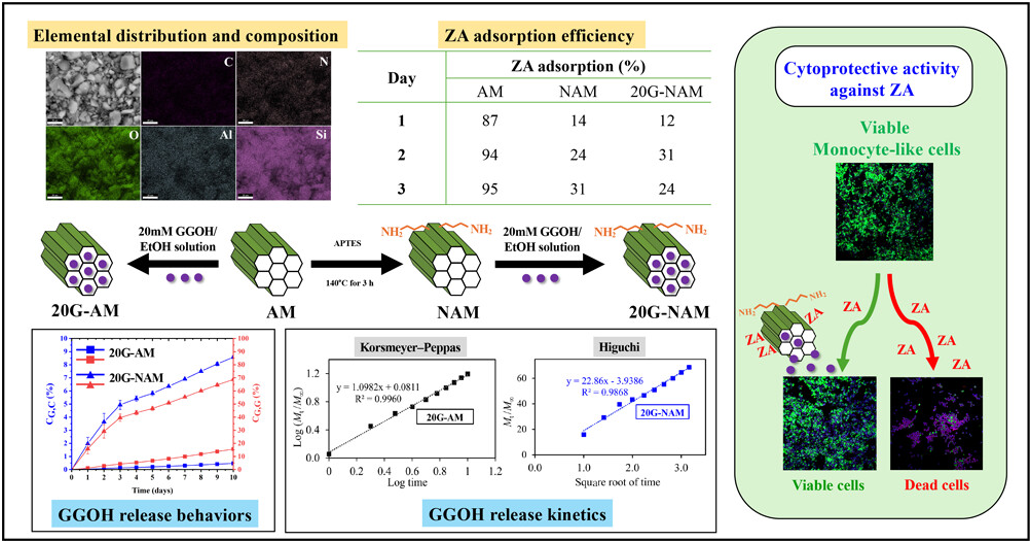
The research team synthesized aluminum-doped mesoporous silica nanoparticles (Al-MCM-41) and further modified them with amine groups using APTES to produce dual-functional nanoparticles called NAM. Aluminum sites were designed to bind ZA efficiently, while amine functionalization improved the loading and controlled release of the hydrophobic compound GGOH. Structural analyses confirmed successful aluminum incorporation and amine functionalization of the nanoparticles. The results showed that the amine-modified nanoparticles (NAM) had a much higher capacity for GGOH loading than unmodified particles, achieving up to 12.48% loading efficiency and sustained GGOH release for more than 10 days. Release kinetics analysis indicated that GGOH release mainly occurred through a diffusion-controlled mechanism. The nanoparticles also demonstrated the ability to adsorb ZA. Aluminum-containing particles without amine modification adsorbed more than 95% of ZA, while the dual-functional NAM particles still retained moderate ZA adsorption (~30%) while providing GGOH delivery. This balance is important because reducing free ZA levels while supplying protective GGOH may help lower drug-induced toxicity.
Biological testing using RAW 264.7 murine cells demonstrated that GGOH-loaded NAM nanoparticles were biocompatible and successfully reversed ZA-induced cytotoxicity and metabolic impairment. The nanoparticles also showed very low hemolytic activity (<0.5%), suggesting good blood compatibility and safety potential.
Overall, this work presents a promising nanomaterial platform that combines drug adsorption and controlled therapeutic delivery for preventing MRONJ. The study provides important preclinical evidence supporting future in vivo and translational biomedical applications.
Reference:
Pichaipanich, P., Singhatanadgit, W., Thavornyutikarn, B., Sungkhaphan, P., Kitpakornsanti, S., Pornsuwan, S., & Janvikul, W. (2025). Dual-functional amine-modified aluminum-doped MCM-41 nanoparticles for concurrent zoledronic acid adsorption and geranylgeraniol delivery for prevention of medication-related osteonecrosis of the jaw. ACS Mater.Au, 5, 1037–1051. https://doi.org/10.1021/acsmaterialsau.5c00112.
