Analyzing intact proteins is important because proteins can serve as biomarkers that help doctors detect diseases, monitor treatment effectiveness, and better understand biological processes. However, separating proteins accurately is challenging because proteins often stick to the inner surface of analytical instruments, which can reduce measurement accuracy and reproducibility. Capillary electrophoresis (CE) is a powerful technique for protein separation, but its performance strongly depends on controlling interactions between proteins and the capillary wall.
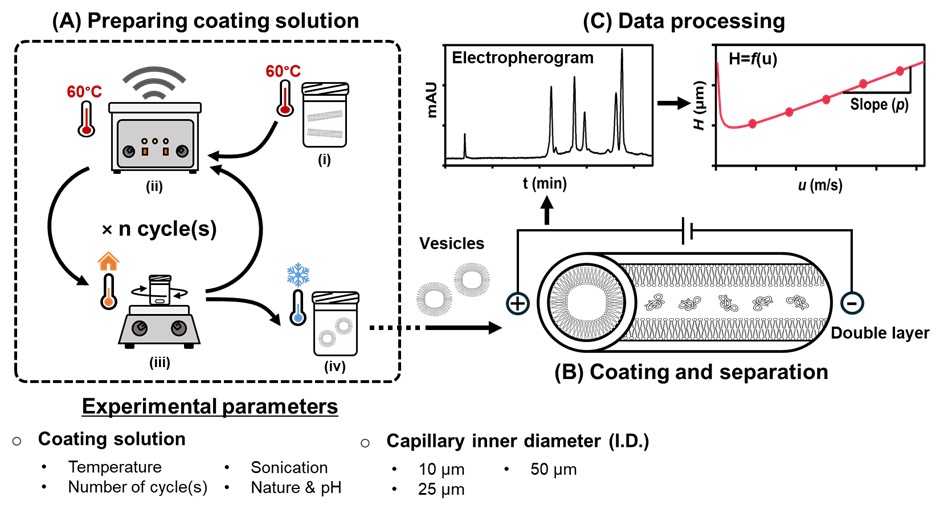
This study aims to improve protein separation in CE by applying a specialized surface coating made from a double-chained cationic surfactant called dioctadecyldimethylammonium bromide (DODAB). This surfactant forms stable vesicle structures that attach to the capillary wall and generate a uniform positively charged surface. The coating helps reduce unwanted protein adsorption and improves the consistency of protein movement during separation.
Key experimental parameters affecting coating performance were systematically investigated, including the preparation temperature, the use of sonication, the type of coating buffer, and the capillary inner diameter. Separation efficiency was evaluated by studying how protein band broadening changes with migration velocity under different applied voltages.
The results demonstrate that the DODAB coating produces a highly uniform surface, leading to excellent separation efficiency and reproducibility. Using five model proteins, the method achieved very high efficiency, reaching up to 606,000 theoretical plates per meter, with minimal variation in migration times. These findings highlight the strong potential of DODAB coatings for reliable protein analysis and suggest promising future applications in clinical diagnostics involving protein biomarkers.
