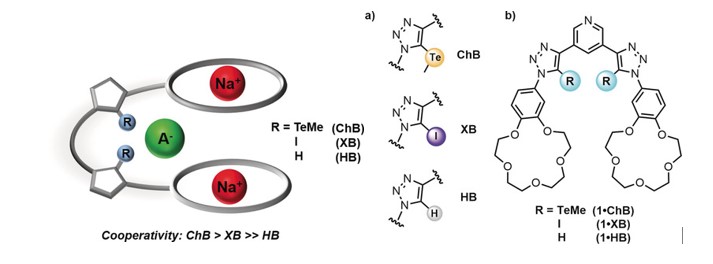
Charged species are ubiquitous, playing crucial roles in biology, medical healthcare and in particular in the environment resulting from polluting anthropogenic chemical industry activities. Cation and anion binding affinities of monotopic receptor systems are critically influenced by the nature of counterions. This has stimulated an ever-increasing interest in the construction of heteroditopic receptors for ion-pair recognition, which are designed to enhance the efficacy of charged guest recognition via favourable intramolecular electrostatic interactions and conformational allosteric cooperativity. Such systems have been demonstrated to facilitate the solubilisation of inorganic salts in organic media, to function as efficient extraction and membrane transport reagents, and to be capable of recognising biologically relevant zwitterionic species.
A heteroditopic receptor typically utilizes Lewis acidic groups and most commonly, various hydrogen bond (HB) donor motifs for recognition of anion guest species. During the last decade or so, the sigma hole bonding interactions halogen bonding (XB) and chalcogen bonding (ChB), which are the attractive non-covalent interactions between an electrophilic halogen or chalcogen atom covalently linked to an electron-withdrawing group and a Lewis base, have been exploited in anion supramolecular chemistry. In particular, XB receptors and more recently ChB hosts have been shown to display contrasting and often superior anion binding strength and selectivities in comparison to HB receptor analogues. Taking this into account, it is surprising that the integration of sigma hole donors into heteroditopic structural host framework design is rare. Indeed, to date, there are only three examples of halogen bonding ion-pair receptors reported and to the best of our knowledge, the incorporation of a chalcogen bond donor group into heteroditopic host structures for ion-pair recognition is unprecedented.
Herein, we report a series of heteroditopic receptors containing halogen (1⋅XB), chalcogen (1⋅ChB), and hydrogen bond (1⋅HB) donors integrated into a 3,5-bis-triazole pyridine structure for anion recognition which is covalently linked to benzo-15-crown-5 ether motifs for sodium cation binding. Importantly, ion-pair binding investigations reveal sodium cation–benzocrown ether binding switches on the recognition of bromide and iodide halide anions. Notably, the chalcogen bonding heteroditopic receptor displays a remarkable enhancement of halide binding strength of over two hundred-fold relative to XB and HB analogues.
Reference:
T. Bunchuay, A. Docker, U. Eiamprasert, P. Surawatanawong, A. Brown, P. D. Beer, Angew. Chem. Int. Ed. 2020, 59, 12007. (https://onlinelibrary.wiley.com/doi/10.1002/anie.202001125)
