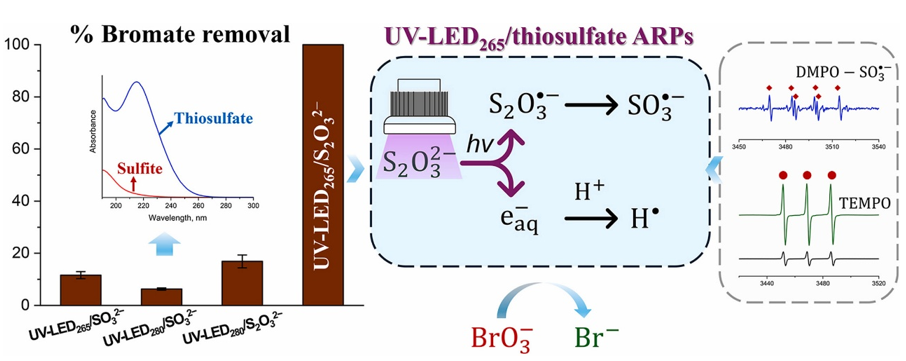
This is a collaboration work with Assoc. Prof. Jenyuk Lohwacharin from the Department of Environmental Engineering, Chulalongkorn University. This study developed a new ultraviolet light-emitting diode (UV-LED)-based advanced reduction process (ARP) to remove bromate from water using thiosulfate as a reducing agent. Bromate is a potentially carcinogenic byproduct commonly formed during ozonation in drinking water treatment, and conventional treatment methods are often ineffective at removing it. The authors investigated the performance of UV-LEDs emitting at 265 nm and 280 nm combined with either sulfite or thiosulfate. Among all tested systems, the UV-LED265/thiosulfate process showed the highest efficiency and completely removed bromate under slightly acidic conditions (pH 6.4). In contrast, the conventional UV-LED/sulfite process removed only a small fraction of bromate under the same conditions. The study showed that UV light activates thiosulfate to produce highly reactive reducing species, especially hydrated electrons (eaq−), hydrogen radicals (H•), and sulfur-containing radicals such as sulfite radicals (SO3•−). These reactive species convert bromate into less harmful bromide ions. Electron paramagnetic resonance (EPR) spectroscopy confirmed the generation of these radicals during the process.
The efficiency of bromate removal depended strongly on operating conditions. The process worked best at mildly acidic conditions (pH 5.8–6.4), and increasing thiosulfate concentration improved the reaction rate. However, naturally occurring ions in water, especially bicarbonate, could interfere with radical reactions and reduce bromate removal efficiency. Importantly, the UV-LED/thiosulfate system showed comparable or lower energy consumption than conventional mercury UV lamp systems while avoiding mercury-related environmental concerns. Because UV-LEDs have long lifetimes, low energy requirements, and no mercury content, the proposed process may provide a more sustainable and environmentally friendly approach for future drinking water treatment applications.
Overall, this work demonstrates that UV-LED/thiosulfate advanced reduction processes can effectively degrade bromate under practical water-treatment conditions and provides new insight into the roles of reactive reductive radicals in water purification chemistry.
Reference:
Phan, K. A., Pornsuwan, S., Oguma, K., & Lohwacharin, J. (2026). Bromate abatement with ultraviolet light-emitting diode/thiosulfate advanced reduction processes: Mechanisms, affecting parameters and applications. J. Environ. Manage., 401, 128835. https://doi.org/10.1016/j.jenvman.2026.128835.
