Taweechai Amornsakchai
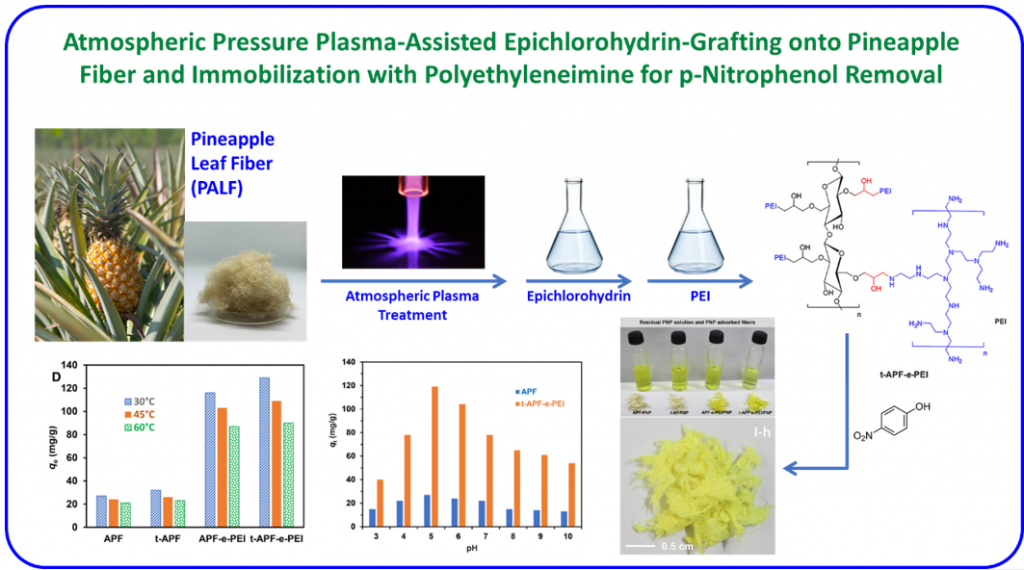
This study developed a low-cost and eco-friendly material made from pineapple leaf fiber, a common agricultural waste, to clean harmful chemicals from water. The researchers treated the fibers using a special plasma technique and added a chemical called polyethyleneimine (PEI) to improve its ability to trap pollutants. The final product was tested to remove p-nitrophenol (PNP), a toxic chemical found in industrial wastewater. The tests showed that this modified fiber could quickly and effectively capture PNP from water, removing up to 128 milligrams per gram of material. This is significantly better than untreated fibers. The way it works is mainly due to the attraction between the positively charged PEI and the negatively charged PNP molecules. The material could be reused several times and still perform well. This research shows that pineapple waste can be turned into an effective and affordable solution for water purification, helping reduce both pollution and agricultural waste.
Reference:
“Atmospheric Pressure Plasma-Assisted Epichlorohydrin-Grafting onto Pineapple Fiber and Immobilization with Polyethyleneimine for p-Nitrophenol Removal”, Saikrasun, S., Amornsakchai, T., Cheerarot, O., Sci. Prog. 2025, 108(3), 368504251360317.