Kanokorn Wechakorn1,*, Phongthon Kanjanasirirat2, Yongyut Pewkliang2, Suparerk Borwornpinyo2,3, and Palangpon Kongsaeree4,5,*
1Department of Chemistry, Faculty of Science and Technology, Rajamangala University of Technology Thanyaburi, Pathumthani 12110, Thailand
2Excellent Center for Drug Discovery, Faculty of Science, Mahidol University, Bangkok 10400, Thailand
3Department of Biotechnology, Faculty of Science, Mahidol University, Bangkok 10400, Thailand
4Department of Chemistry and Center of Excellence for Innovation in Chemistry, Faculty of Science, Mahidol University, Bangkok 10400, Thailand
5Center for Excellence in Protein and Enzyme Technology, Faculty of Science, Mahidol University, Bangkok 10400, Thailand
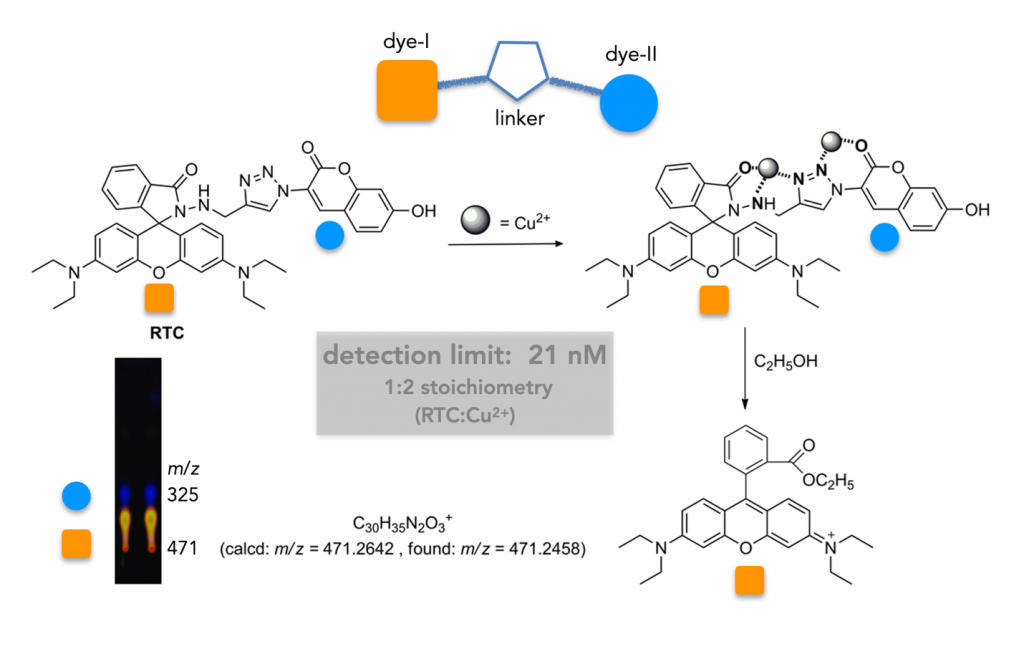
Copper is an essential metal in the human body, but too much of it can be harmful and lead to diseases like Alzheimer’s and Wilson’s disease. To detect copper in biological systems, we have developed a new fluorescent sensor called RTC. This sensor is made by combining two fluorescent molecules, rhodamine and coumarin, using a click chemistry reaction.
RTC is highly selective for copper, meaning it does not react with other metals. When copper ions are present, RTC changes color from colorless to pink and emits a strong fluorescent signal, making it easy to detect. The sensor works across a wide pH range and can detect extremely low copper concentrations—down to 21 nanomolar.
In laboratory tests, RTC successfully detected copper in living cells (HEK293T cells) under a fluorecent microscope. It also showed no toxic effects on the cells. Additionally, researchers attached RTC to a solid support (Merrifield resin) to develop a reusable detection system.
Overall, this study presents RTC as a promising tool for detecting copper in biological and environmental samples, with potential applications in medical diagnostics and environmental monitoring.
Reference: Wechakorn, K., Pitsanuwong, C., Kanjanasirirat, P. et al. A Rhodamine-coumarin Triazole Conjugate as a Fluorescent Chemodosimeter for Cu(II) Detection and its Application in Live Cell Bioimaging. J Fluoresc 34, 2571–2581 (2024). https://doi.org/10.1007/s10895-023-03460-4