Ketsarin Chantarasunthon a, Malinee Promkatkaew a, Patthreera Waranwongcharoen a,
Anek Sueksachat a, Nitchanan Prasop a, Thanaporn Norasi a, Narisa Sonsiri a, Sirirat Sansern a, Sinchai Chomngam b, Kanokorn Wechakorn c, Chanat Thana a, Wissawat Sakulsaknimitr a, Palangpon Kongsaereeb, Pailin Srisuratsiria,*
a Department of Basic Science and Physical Education, Faculty of Science at Sriracha, Kasetsart University Sriracha Campus, Chonburi 20230, Thailand
b Department of Chemistry and Center for Excellence in Protein and Enzyme Technology, Faculty of Science, Mahidol University, Bangkok 10400, Thailand
c Department of Chemistry, Faculty of Science and Technology, Rajamangala University of Technology Thanyaburi, Pathumthani 12110, Thailand
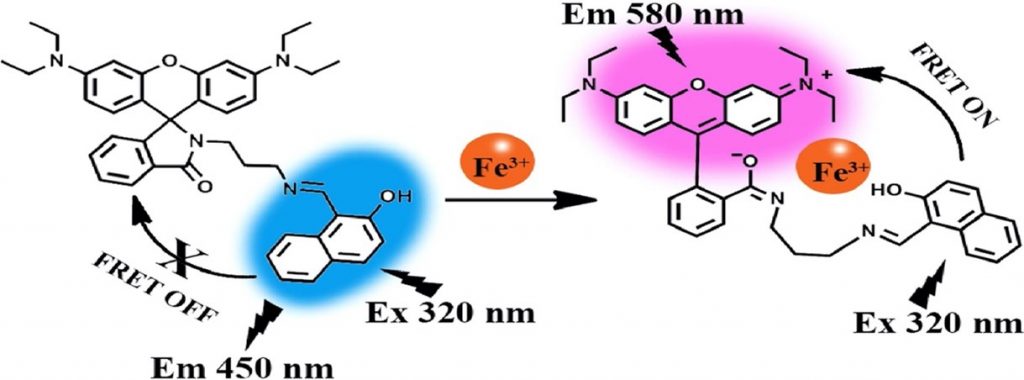
We have developed a highly selective fluorescence sensor, called Naph-Rh, to detect iron ions (Fe³⁺) in water and biological samples. Iron plays an essential role in various biological processes, including oxygen transport and enzyme activity. However, excessive iron levels can be harmful, leading to diseases such as Alzheimer’s, Parkinson’s, and organ damage. Detecting Fe³⁺ accurately and efficiently is crucial for environmental monitoring and medical diagnostics.
Naph-Rh is a a new chemosensor based on fluorescence resonance energy transfer (FRET), a mechanism where energy transfers between two connected molecules, producing a strong fluorescence signal when Fe³⁺ is present. This sensor combines naphthyl (a donor molecule) and rhodamine B (an acceptor molecule) with a short linker, optimizing its ability to detect Fe³⁺ specifically. It shows a clear color change from colorless to pink upon binding to Fe³⁺, making detection simple and visible.
The sensor demonstrates excellent sensitivity, with a detection limit as low as 83 nanomolar (nM). This means it can detect Fe³⁺ even in very low concentrations, making it suitable for real-world applications. Additionally, computational simulations using Density Functional Theory (DFT) confirm the sensor’s mechanism and efficiency. The results suggest that the sensor’s structure is well-designed for Fe³⁺ binding, ensuring high selectivity without interference from other metal ions.
Naph-Rh provides a promising tool for detecting Fe³⁺ in biological and environmental systems. Its high sensitivity, fast response time, and ease of use make it valuable for scientific research, water quality testing, and medical diagnostics. This innovation contributes to the ongoing development of more effective and practical metal ion sensors.
Reference: Chantarasunthon K., Promkatkaew M., Waranwongcharoen P., Sueksachat A., Prasop N., Norasi T., Sonsiri N., Sansern S., Chomngam S., Wechakorn K., Thana C., Sakulsaknimitr W., Kongsaeree P., Srisuratsiri P. A novel highly selective FRET sensor for Fe(III) and DFT mechanistic evaluation. Spectrochimica Acta – Part A: Molecular and Biomolecular Spectroscopy, 286, 2023, 122031. https://doi.org/10.1016/j.saa.2022.122031