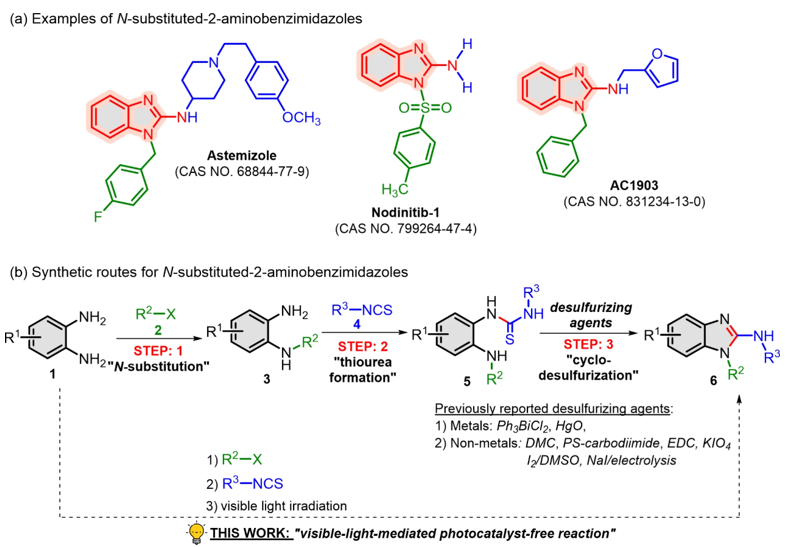
This is a collaboration work with Professor Dr. Sumrit Wacharasindhu at the Department of Chemistry, Chulalongkorn University. This study developed a mild and environmentally friendly method for synthesizing N-substituted 2-aminobenzimidazoles using visible light without requiring any photocatalyst. These compounds are important heterocyclic molecules commonly found in pharmaceutical and medicinal chemistry, including antihistamines and ion-channel inhibitors. Conventional synthesis methods often require toxic reagents, harsh conditions, or multi-step purification processes. The authors designed a one-pot reaction that combines three steps in a single reaction vessel: N-substitution of o-phenylenediamines, thiourea formation with isothiocyanates, and visible-light-mediated cyclodesulfurization. The reaction was performed under mild conditions at room temperature using ethanol/water solvent mixtures and blue LED light under open-air conditions. Importantly, the reaction proceeded efficiently without any metal-based or organic photocatalyst. Optimization studies showed that a 3 Watt-blue LED provided excellent yields while shortening the reaction time compared with white LEDs. The method successfully synthesized a wide range of structurally diverse N-substituted 2-aminobenzimidazoles, including aryl, heterocyclic, and alkyl derivatives, with yields up to 92%. The process was also demonstrated on gram scale, showing that the method is practical and scalable for larger-scale synthesis. In addition, the reaction tolerated many functional groups, including halogens, alkyl groups, and protected phenolic substituents.
Mechanistic experiments, including light on/off studies, oxygen-dependence tests, radical trapping experiments, and EPR analysis, suggested that the reaction proceeds through a visible-light-induced radical pathway. Reactive oxygen species and sulfur-centered radical intermediates were proposed to play important roles in the cyclodesulfurization process.
Overall, this work presents a simple, scalable, and greener synthetic approach for preparing pharmaceutically relevant benzimidazole compounds while avoiding toxic desulfurizing agents and photocatalysts. The method may contribute to more sustainable organic synthesis in medicinal and pharmaceutical chemistry.
Reference:
Rerkrachaneekorn, T., Annuur, R. M., Pornsuwan, S., Sukwattanasinitt, M., & Wacharasindhu, S. (2025). A mild and scalable one-pot synthesis of N-substituted 2-aminobenzimidazoles via visible light mediated cyclodesulfurization. Sci. Rep., 15, 4096. https://doi.org/10.1038/s41598-025-86772-8.
