Kanokorn Wechakorn a,b, Utt Eiamprasert a, Jintana Masoongnoen a, Ajcharaphan Tantipanjaporn c,d, Panida Surawatanawong c, Phongthon Kanjanasirirat e, Yongyut Pewkliang e, Suparerk Borwornpinyo e,f, Palangpon Kongsaeree c,d, Chariwat Pitsanuwong g
a Department of Chemistry, Faculty of Science and Technology, Rajamangala University of Technology Thanyaburi, Pathum Thani, 12110, Thailand
b Advanced Photochemical and Electrochemical Materials Research Unit, Faculty of Science and Technology, Rajamangala University of Technology Thanyaburi, Pathum Thani, 12110, Thailand
c Department of Chemistry, Faculty of Science, Mahidol University, Bangkok, 10400, Thailand
d Center for Excellence in Protein and Enzyme Technology, Faculty of Science, Mahidol University, Bangkok, 10400, Thailand
e Excellent Center for Drug Discovery, Faculty of Science, Mahidol University, Bangkok, 10400, Thailand
f Department of Biotechnology, Faculty of Science, Mahidol University, Bangkok, 10400, Thailand
g Faculty of Science and Technology, Suan Sunandha Rajabhat University, Bangkok, 10300, Thailand
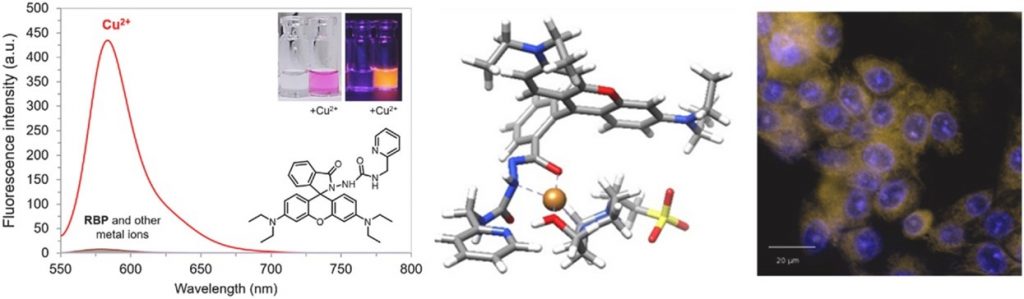
We have developed a new fluorescent sensor to detect copper ions (Cu²⁺) in water samples and human liver cancer cells (HepG2). Copper is essential for biological functions, but too much can be toxic, leading to diseases like Alzheimer’s and Parkinson’s. Industrial pollution can also introduce harmful levels of copper into water sources.
The new sensor, called RBP, is based on rhodamine-semicarbazide and changes color from colorless to pink when it detects Cu²⁺. It also produces a strong fluorescent signal, making detection easy and highly sensitive. The sensor can detect copper at very low concentrations (as low as 5.8 nanomolar) and works within one minute. This makes it faster and more effective than many existing methods, which often require expensive and complex equipment.
Tests show that the sensor works well in real water samples and provides accurate results. Additionally, it is safe for biological applications, as it was used to successfully image copper ions in HepG2 cells without significant toxicity.
This sensor offers a simple, fast, and reliable way to monitor copper contamination in water and biological systems, with potential applications in environmental monitoring and medical research.
Reference: Wechakorn K., Eiamprasert U., Masoongnoen J., Tantipanjaporn A., Surawatanawong P., Kanjanasirirat P., Pewkliang Y., Borwornpinyo S., Kongsaeree P., Pitsanuwong C. A highly sensitive and selective rhodamine-semicarbazide based fluorescent sensor for Cu2+ detection in real water samples and fluorescence bioimaging in HepG2 cells. Talanta, 270, 2024, 125530. DOI: 10.1016/j.talanta.2023.125530