Pranee Phinyocheep
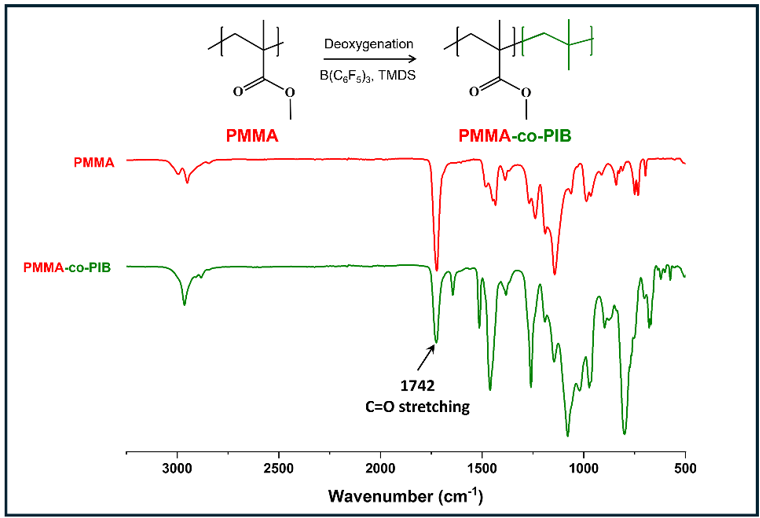
Poly(methyl methacrylate) or PMMA is a versatile material because of its ease of manipulation and biocompatibility. However, brittleness limits its applications; hence, copolymerization of PMMA with rubber such as polyisobutylene (PIB) is required. PMMA-co-PIB preparation by conventional copolymerization requires the purification of co-monomers under an inert atmosphere. In this study, the transformation of PMMA into PMMA-co-PIB was explored using a deoxygenation reaction. PMMA was treated with tris(pentafluorophenyl) borane and 1,1,3,3-tetramethyldisiloxane (TMDS) at room temperature, 50, and 70 °C for 1, 2, and 3 day reaction times. FTIR results revealed a reduction in the ester functional group of PMMA at 1724 cm–1. PMMA was partially converted into PIB moieties, forming PMMA-co-PIB. The highest degree of deoxygenation (48.2%) was obtained after a reaction for 1 day at room temperature. When the PIB structure was present in the PMMA backbone, the PMMA glass transition temperature (115.6 °C) was shifted to a lower temperature (83.7°C). A significant decrease in the modulus of PMMA from 3.40 to 1.29 GPa (PMMA-co-PIB) reveals improved toughness. This straightforward post-polymerization approach involving the deoxygenation of PMMA offers a promising, simple, and mild condition for synthesizing PMMA-co-PIB. This will enable new applications in medical appliances or high-value coating materials.
Reference: K. Longkaew, P. Daniel, T. Amornsakchai, T. Ratvijitvech, and P. Phinyocheep