Pasita Nakdee,[a] Patcharapa Chapradit,[a] Lueacha Tabtimmai,[b],[c] Sorachat Tharamak,[d] Worakrit Saiyasombat,[e] Tanakorn Wonglakhon,[f] Anyanee Kamkaew,[g] Mongkol Sukwattanasinitt,[h] Chutima Kuhakarn,[i] Onnicha Khaikate,[a],*
[a] Department of Industrial Chemistry, Faculty of Applied Science, King Mongkut’s University of Technology North Bangkok, Bangkok 10800, Thailand
[b] Department of Biotechnology, Faculty of Applied Science, King Mongkut’s University of Technology North Bangkok, Bangkok, 10800, Thailand
[c] Food and Agro-Industrial Research Center, King Mongkut’s University of Technology North Bangkok, Bangkok, 10800, Thailand
[d] Department of Chemistry, Faculty of Science, Kasetsart University, Bangkok, 10900, Thailand
[e] Institute of Nutrition, Mahidol University, Phutthamonthon, Nakhon Pathom 73170, Thailand
[f] Futuristic Science Research Center, School of Science, Walailak University, Nakhon Si Thammarat, 80160, Thailand
[g] School of Chemistry, Institute of Science, Suranaree University of Technology, Nakhon Ratchasima 30000, Thailand
[h] Department of Chemistry, Faculty of Science, Chulalongkorn University, Bangkok, 10330, Thailand
[i] Department of Chemistry and Center of Excellence for Innovation in Chemistry (PERCH-CIC), Faculty of Science, Mahidol University, Rama 6 Road, Bangkok 10400, Thailand
The present work reports a family of donor--acceptor (D– –A) fluorescent probes based on 2-(3-cyano-4,5,5-trimethylfuran-2(5H)-ylidene)malononitrile (TCF) as effective platforms for viscosity sensing in complex systems. The probes exhibited pronounced fluorescence enhancement in response to increasing viscosity, which is attributed to the restriction of intramolecular rotation. These probes exhibited favorable photophysical properties, including large Stokes shifts of up to 233 nm in aqueous media and far-red to near infrared emission (650–900 nm), enabling high sensitivity with minimal background interference. They also demonstrated broad pH tolerance, excellent selectivity, and high photostability, supporting their suitability for practical sensing applications. The applications were demonstrated through the monitoring of thermal degradation in six edible oils (sunflower, coconut, palm, olive, canola, and soybean), evaluation of spoilage in apple juice, and imaging of intracellular viscosity in cancer cells without sample pretreatment. Computational studies further supported the experimental observations and provided mechanistic insights into the photophysical behavior of these probes. This work demonstrates that TCF-based fluorescent probes provide a simple, sensitive, and versatile platform for real-time viscosity sensing with promising applications in food quality monitoring and biomedical imaging.
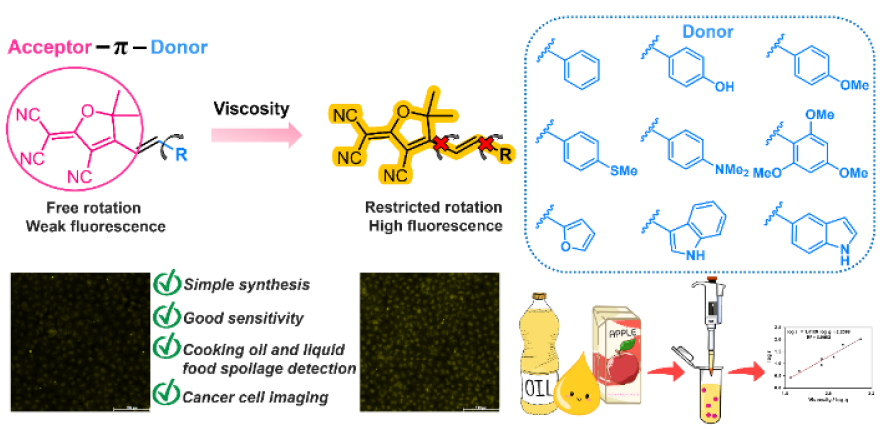
Nakdee, P.; Chapradit, P.; Tabtimmai, L.; Tharamak, S.; Saiyasombat, W.; Wonglakhon, T.; Kamkaew, A.; Sukwattanasinitt, M.; Kuhakarn, C.; Khaikate, O. Small-molecule D–π–A fluorescent probes for viscosity detection and its applications in cooking oils, food spoilage, and cell imaging. Dyes and Pigments 2026, 254, 113990. DOI: 10.1016/j.dyepig.2026.113990.
