Andrew Docker, Dr.Thanthapatra Bunchuay, Michael Ahrens, Dr.Antonio J. Martinez-Martinez, Prof. Paul D. Beer
The plethora of roles that charged species play in biological, environmental and technological spheres has resulted in the burgeoning field of supramolecular host-guest chemistry, which focuses on the construction of synthetic receptors for the selective recognition and sensing of a vast array of cationic and anionic species.1–3 However, necessarily implicated in the recognition of a given charged species is the presence of its counterion(s), which has been demonstrated to dramatically affect the binding behaviour of monotopic host systems. Heteroditopic receptors, incorporating both cation and anion binding sites, are capable of exploiting this interplay between co-bound ion-pairs, enhancing the efficacy of charged guest recognition via favourable intramolecular electrostatic interactions and conformational allosteric cooperativity, relative to monotopic analogues.4–9 Although recent years have seen a diversification in strategies to affect cation complexation, such as cation-π interactions10–12 or the employment of interlocked receptor topologies,13–15 to elicit highly specific interaction modes, the commensurate anion binding motif variation in ion-pair receptor design has been largely restricted to hydrogen bond donors.7–9 The sigma-hole non-covalent interactions, halogen bonding (XB) and chalcogen bonding (ChB), have been shown to exhibit potent anion binding strength and selectivities, which includes superior enantioselectivity17 and sensory response output, in comparison to analogous hydrogen bonding (HB) receptor analogues.18–21 Despite this, their incorporation into heteroditopic structural host frameworks is rare, with only a handful of examples of XB and one ChB ion-pair receptor reported to date.13, 22–25
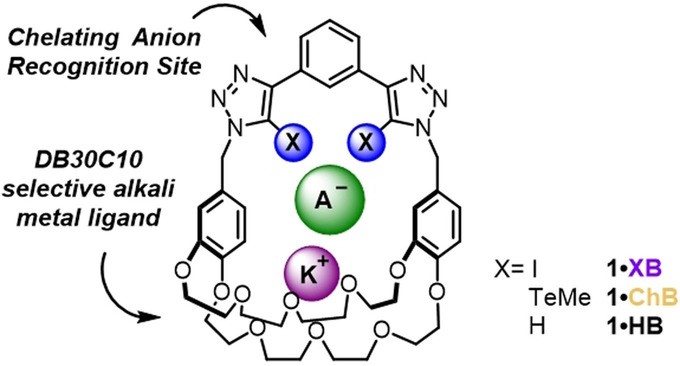
Herein, we report the first sigma-hole heteroditopic cryptands, which feature a dibenzo-30-crown-10 (DB30C10) motif for potassium cation binding, bridged by bidentate ChB, and XB donors for anion recognition. (Figure 1). Ion-pair binding investigations notably demonstrate DB30 C10-potassium cation encapsulation switches on bromide and iodide halide recognition. Importantly, the nature of the sigma-hole mediated anion binding interaction dramatically influences both halide affinity and selectivity, with the chalcogen bonding heteroditopic cryptand exhibiting significant discrimination between the two potassium halide salts.
Reference
A. Docker, T. Bunchuay, M. Ahrens, A. J. Martinez-Martinez, P. D. Beer, Chem. Eur. J. 2021, 27, 7837.
(https://chemistry-europe.onlinelibrary.wiley.com/doi/10.1002/chem.202100579)
