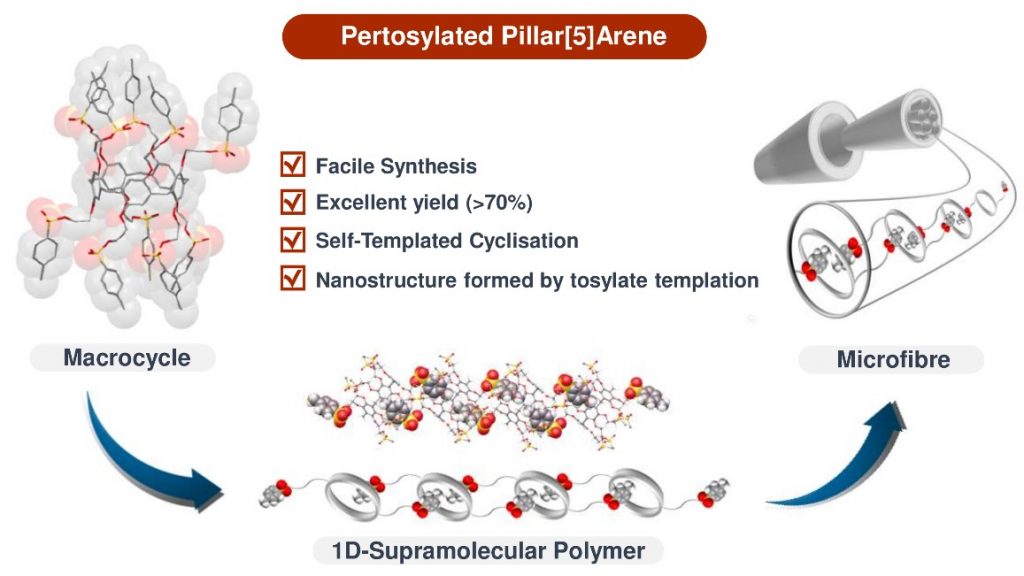
Since Cram, Lehn, and Pedersen set the milestones in supramolecular host–guest chemistry, macrocyclic motifs have served as workhorses in the area of molecular assembly, primarily due to their accessibility, and their established complementarity for a wide variety of guest molecules. In 2008, Ogoshi and co-workers reported their seminal work on the synthesis of a series of novel macrocycles, coined pillararenes, the multifaceted exterior surface of which bears resemblance to their namesake.3 Structurally, these macrocycles are cyclic oligomers (n = 5–15) of dialkylated hydroquinone monomers covalently linked by methylene spacer units at the 2,5-positions, forming a highly symmetric and rigid cavity. Considering the cavity size and its constituent electron-rich aromatic units, it is unsurprising that pillar[5]arenes are capable of forming inclusion complexes with electron deficient guests, binding a range of linear aliphatic and some simple aromatic molecules. However, compared to other macrocyclic hosts such as calixarenes and crown ethers, pillararenes have a remarkable affinity towards neutral guest species. Moreover, the derivatisation of the rim of pillararenes provides an opportunity to fine-tune their recognition environments. These advantages highlight the potential of pillararenes as an effective and highly tunable motif for self-assembly in the construction of supramolecular polymers. Indeed, Huang and co-workers demonstrated that a monooctyl functionalised pillar[5]arene can selfassemble into a linear supramolecular network in chloroform solution, whilst changing the side chain to a terminal bromododecyl group switches the assembly mode to form a daisy-chain dimeric species. The interpenetrated complexes formed between pillar[5]arenes and other neutral aliphatic molecules have also been employed in the preparation of supramolecular polymers. In this context, reports of templation by a neutral aromatic moiety have been restricted to imidazole and triazole derivatives.
Although the unique properties that multivalency confers on supramolecular complexes have been known for several years, applications of highly functionalised pillararene derivatives are rare.10 Indeed, the overwhelming majority of pillar[5]arene-based receptors, polymers or functional materials have employed mono or bis-functionalised derivatives.10 The reason is that the synthesis of fully functionalised pillar[5]arene scaffolds remains challenging, requiring numerous synthetic steps or suffering from low yields of macrocyclisation.3d In this work, we prepared a pertosylated pillar[5]arene 1 in high yield (47%) as a useful precursor to prepare a wide range of pillar[5]arene derivatives via post-synthetic modifications. Importantly, we demonstrate that the tosylate side chain in monomer 2 aids cyclisation by self-templation in the absence of a templating solvent. A suite of techniques including; 1H–1H DOSY NMR spectroscopy, dynamic light scattering, viscosity measurements and X-ray crystallography, confirm the formation of a linear supramolecular polymer, 1 in solution and the solid state, induced by the template effect of the pendant tosylate group.
Reference
A. Ruengsuk, K. Khamphaijun, P. Pananusorn, A. Docker, J. Tantirungrotechai, M. Sukwattanasinitt, D. J. Harding and T. Bunchuay, Chem.Commun., 2020, 56, 8739-8742.
(https://pubs.rsc.org/en/content/articlelanding/2020/CC/D0CC04005C)
