Suppisak Chaturonrutsamee,[a,b,c] Chutima Kuhakarn,[a,b] Sariyarach Thanasansurapoung,[b] Samran Prabpai,[b] Arthit Chairoungdua,[d] Radeekorn Akkarawongsapat,[e] Narong Nuntasaen,[b] Sakchai Hongthong,[f] Bodee Nutho,[g] Vichai Reutrakul[a,b]*
[a] Department of Chemistry, Faculty of Science, Mahidol University, Rama VI Road, Bangkok 10400, Thailand
[b] Center of Excellence for Innovation in Chemistry (PERCHCIC), Faculty of Science, Mahidol University, Rama VI Road, Bangkok 10400, Thailand
[c] Research and Innovation Department, International Laboratories Corp., Ltd., Bang Phli, Samut Prakan 10540, Thailand
[d] Department of Physiology, Faculty of Science, Mahidol University, Rama VI Road, Bangkok 10400, Thailand
[e] Department of Microbiology, Faculty of Science, Mahidol University, Rama VI Road, Bangkok 10400, Thailand
[f] Science and Innovation for Development Program, and Division of Chemistry, Faculty of Science and Technology, Rajabhat Rajanagarindra University, Chachoengsao 24000, Thailand
[g] Department of Pharmacology, Faculty of Science, Mahidol University, Rama VI Road, Bangkok 10400, Thailand
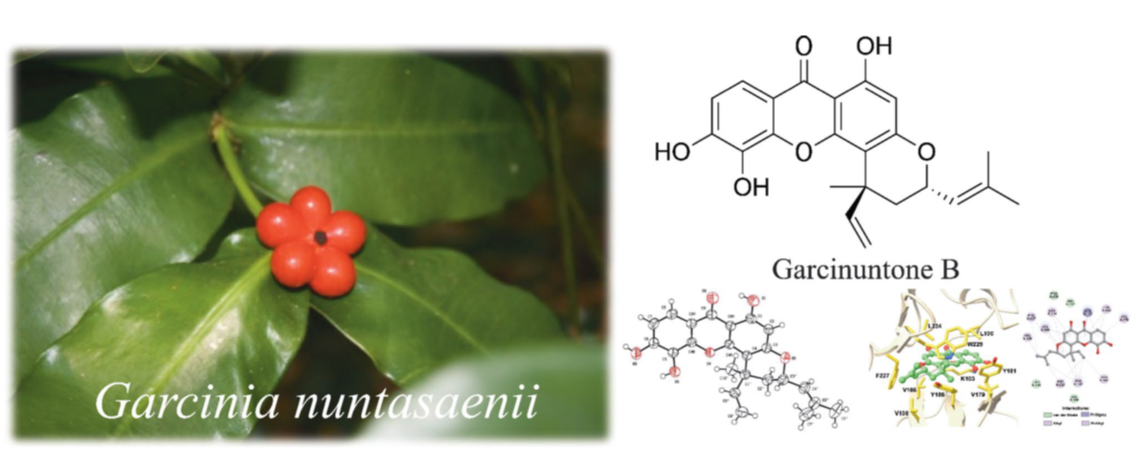
Three previously undescribed polyprenylated xanthone derivatives named garcinuntones A-C, together with fifteen known compounds were isolated from the leaves and twigs of Garcinia nuntasaenii Ngerns. & Suddee (Clusiaceae). Cytotoxic activity against several cancer cell lines and anti-HIV-1 activity assays of some isolated compounds were evaluated. Garcinuntone B exhibited cytotoxicity against some tested cell lines with IC50 values in the range of 4.82 to 6.92 μM. In anti-HIV-1 assays, garcinuntone B demonstrated selective activity against the reverse transcriptase (RT) enzyme, showing an IC50 of 23.61 μM. Tthe binding affinity of garcinuntone B to HIV-1 RT was assessed through molecular docking study. Like other non-nucleoside RT inhibitors, garcinuntone B showed stable number of contacts with the binding residues in the binding pocket of HIV-1 RT enzyme.