Hyunchul Kwon, Leander I. Held, Mykhaylo Ozerov, Ryan A. Murphy, Khetpakorn Chakarawet, Priya Patel, T. David Harris, Nicholas F. Chilton,* and Jeffrey R. Long*
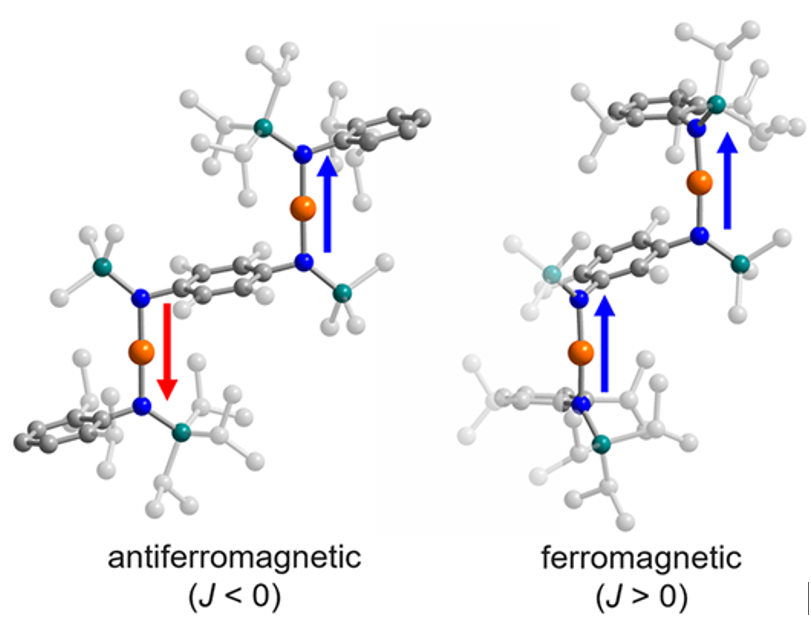
This study demonstrates how the arrangement of atoms within a molecule can be used to control its magnetic properties. Three compounds containing two linear iron(II) or cobalt(II) ions connected by an organic bridge were synthesized. By changing the positions of attachment, the magnetic moments of the two ions either align in the same direction or oppose each other. In particular, the iron compound with a meta-connected bridge behaves as a single-molecule magnet. It exhibits a magnetic relaxation barrier of 139 cm–1, the highest reported for a single-molecule magnet containing multiple transition-metal ions. Connecting the two iron centers also greatly improve remnant magnetization due to quenching of quantum tunneling of magnetization. These findings provide a promising molecular design strategy for developing more potent magnets with potential applications in information storage and quantum technologies.
Reference: J. Am. Chem. Soc. 2026, DOI: 10.1021/jacs.6c07793.