Kornthip Tangthana-umrunga, Siriporn Tarapornb, Sirinapa DokDuangb, Hattaya Benya-aphikulb, Anawat Tailangkaa, Jittra Kornsakulkarnc, Varomyalin Tipmaneeb, Chawanee Thongpanchangc, Potchanapon Graidistb,*, Tienthong Thongpanchanga,*
aDepartment of Chemistry and Center of Excellence for Innovation in Chemistry (PERCH–CIC), Faculty of Science, Mahidol University, Rama 6 Road, Bangkok, 10400, Thailand
bDepartment of Biomedical Sciences and Biomedical Engineering, Faculty of Medicine, Prince of Songkla University, Songkhla, 90110, Thailand
cNational Center for Genetic Engineering and Biotechnology (BIOTEC), 113 Thailand Science Park, Phaholyothin Road, Klong Luang, Pathumthani, 12120, Thailand
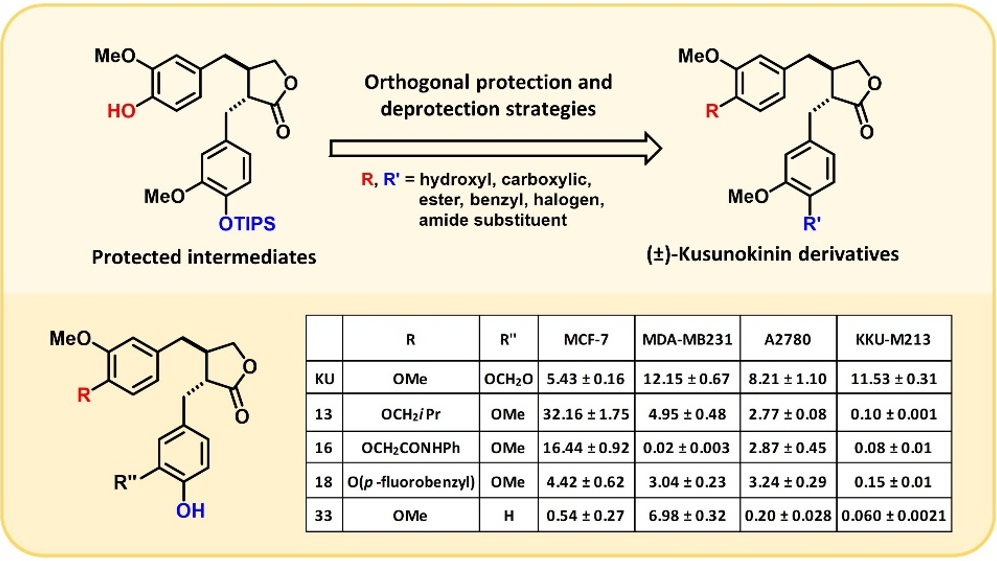
A series of kusunokinin derivatives was designed and synthesized to investigate how changes in their chemical structure influence their anticancer activity. Structural modifications were introduced at different positions of the molecule to identify features associated with improved biological activity. The synthesized compounds were evaluated against cholangiocarcinoma and breast cancer cell lines, and their effects on normal cells were also assessed. Four derivatives were found to exhibit strong cytotoxic activity against cancer cells while showing lower toxicity toward normal cells, indicating their potential as promising lead compounds. Enhanced anticancer activity was observed in derivatives containing alkoxy or phenyl substituents at one position and a hydroxyl group at another. In contrast, the contribution of a methoxy group at a third position could not be clearly established and requires further investigation. Differences were also observed between computational predictions and experimental results, emphasizing that laboratory validation remains essential during the development of potential anticancer agents.
Tangthana-umrung, K.; Taraporn, S.; DokDuang, S.;
Benya-aphikul, H.; Tailangka, A.; Kornsakulkarn, J.; Tipmanee, V.;
Thongpanchang, C.; Graidist, P.; Thongpanchang, T. Eur. J. Med. Chem. 2026,
308, 118677.
