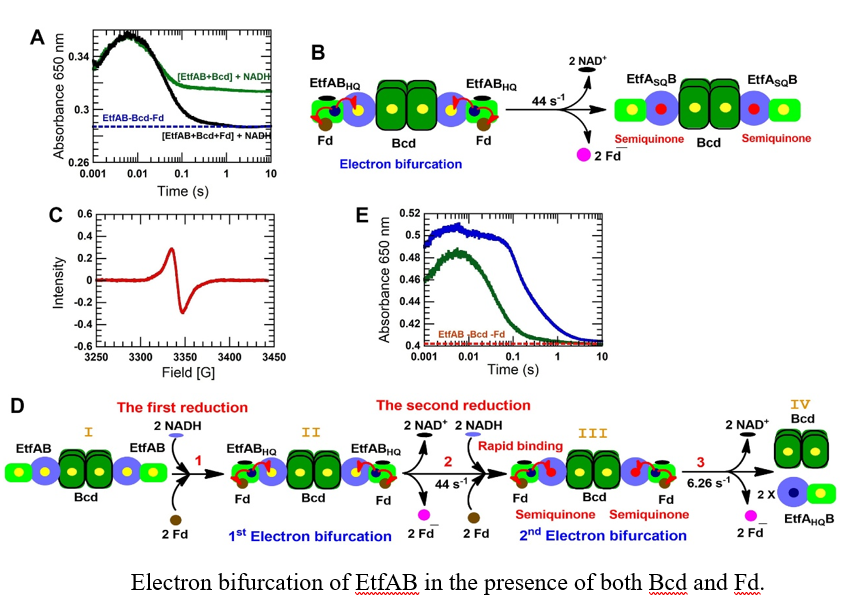
This is a collaboration work with Prof. Dr. Jeerus Sucharitakul at the Faculty of Dentistry, Chulalongkorn University. This study investigated how a bacterial enzyme system carries out a special energy-conserving process called electron bifurcation. The researchers focused on a protein complex from the anaerobic bacterium Acidaminococcus fermentans involving electron transfer flavoprotein (EtfAB), butyryl-CoA dehydrogenase (Bcd), ferredoxin (Fd), and NADH. Electron bifurcation is an important biological mechanism that allows microorganisms to efficiently distribute electrons from one energy source into two separate pathways with different energy requirements. Using rapid kinetic measurements and electron paramagnetic resonance (EPR) spectroscopy, the authors analyzed how electrons move between flavin cofactors inside the protein complex. The study revealed that the process operates through a previously unclear “semiquinone cycle,” in which flavin semiquinone radicals play central roles during electron transfer. The experiments showed that interactions between all five components are required for efficient electron bifurcation.
The authors found that Bcd helps overcome an inhibitory effect caused by the α-FAD semiquinone radical, allowing rapid reduction of β-FAD and continuous catalytic turnover. In the presence of both Bcd and ferredoxin, electrons from NADH are split so that one electron reduces ferredoxin while the other generates flavin semiquinone intermediates. A second bifurcation step then produces fully reduced flavin species that transfer electrons to Bcd for crotonyl-CoA reduction. The study also showed that crotonyl-CoA binding strongly accelerates electron transfer between EtfAB and Bcd. Structural rearrangements within the protein complex were proposed to control the rate of electron transfer. Temperature-dependent experiments demonstrated that the reaction becomes significantly faster at 30 °C, which matches the optimal growth temperature of the bacterium.
Importantly, EPR spectroscopy confirmed the formation of flavin semiquinone radicals throughout the catalytic cycle. These radical intermediates are essential for coupling energetically favorable and unfavorable electron-transfer reactions.
Overall, this work provides new mechanistic insight into flavin-based electron bifurcation, an important biological energy-conservation strategy used by anaerobic microorganisms. The findings improve understanding of microbial metabolism and may contribute to future developments in bioenergetics, synthetic biology, and biocatalysis.
Reference:
Sucharitakul, J., Mangkalee, M., Intasian, P., Pornsuwan, S., Ermler, U., Buckel, W., & Chaiyen, P. (2025). Kinetic mechanisms of electron bifurcation with electron transfer flavoprotein, NADH, butyryl-CoA dehydrogenase, and ferredoxin reveal a semiquinone cycle. J. Biol. Chem., 301(10), 110727. https://doi.org/10.1016/j.jbc.2025.110727.
