Thanathip Chomphunuch,[a,b] Kannika La-ongthong,[a,b] Praewpan Katrun,[c,d] Natthapat Sawektreeratana,[a,b] Natchayatorn Keawkla,[a,b] Darunee Soorukram,[a,b] Pawaret Leowanawat,[a,b] Vichai Reutrakul,[a,b] Panida Surawatanawong,[a,b] Thanthapatra Bunchuay,[a,b] and Chutima Kuhakarn[a,b]*
[a] Department of Chemistry, Faculty of Science, Mahidol University, Rama VI, Road, Bangkok 10400, Thailand
[b] Center of Excellence for Innovation in Chemistry (PERCH-CIC), Faculty of Science, Mahidol University, Rama VI Road, Bangkok 10400, Thailand
[c] Department of Chemistry, Faculty of Science, Khon Kaen University, Khon Kaen 40002, Thailand
[d] Center of Excellence for Innovation in Chemistry (PERCH-CIC), Faculty of Science, Khon Kaen University, Khon Kaen 40002, Thailand
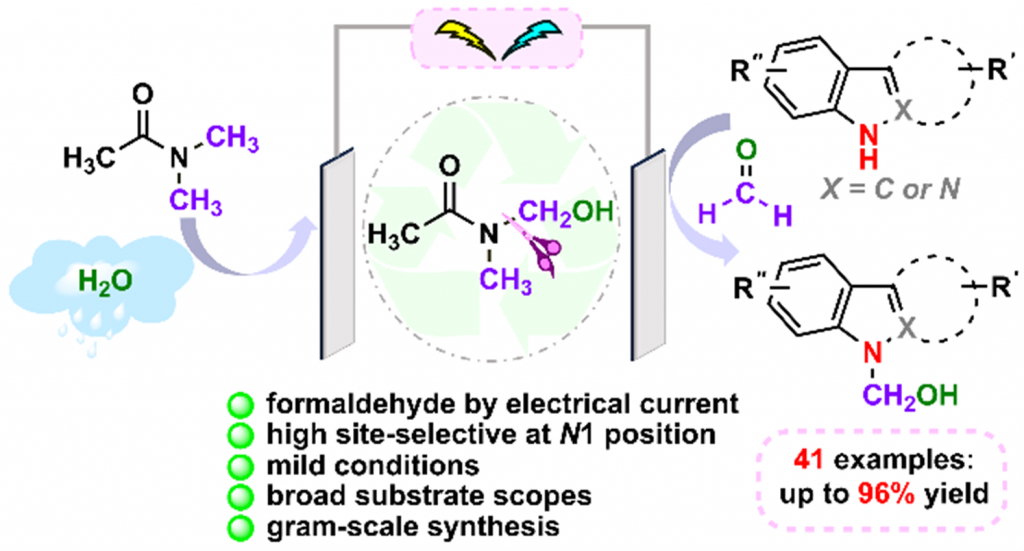
An electrochemical site-selective N-hydroxymethylation of indoles and derivatives using N,N-dimethylacetamide (DMA) as a carbon source was described. The reaction proceeded under mild conditions offering an alternative route to access N-hydroxymethylatated indole, bis-indole, carbazole, and indazole derivatives. In the synthetic transformation, an electrical current was used in place of the metallic-based reagents. Included in the present work are experimental studies to validate the reaction mechanism suggesting N-(hydroxymethyl)-N-methylacetamide generated in situ from DMA/H2O under electrochemical conditions serves as a formaldehyde surrogate. A gram-scale synthesis was demonstrated to show the scaled-up applicability of this transformation.
Reference: Chomphunuch, T.; La-ongthong, K.; Katrun, P.; Sawektreeratana, N.; Keawkla, N.; Soorukram, D.; Leowanawat, P.; Reutrakul, V.; Surawatanawong, P.; Bunchuay, T.; Kuhakarn, C. Electrochemically driven site-selective N-hydroxymethylation of indoles and derivatives. Chem. Asian J. 2025, 20(7), e202401489. DOI: 10.1002/asia.202401489
Web Link: https://aces-onlinelibrary-wiley-com.ejournal.mahidol.ac.th/doi/10.1002/asia.202401489