Wilaiwan Kaenyinga, Takayoshi Tagamib, Eukote Suwanc, Chariwat Pitsanuwongd , Sinchai Chomngame, Masayuki Okuyamab, Palangpon Kongsaereee, Atsuo Kimurab, Prachumporn T. Kongsaereea
aDepartment of Biochemistry, Faculty of Science, Kasetsart University, Bangkok 10900, Thailand
bResearch Faculty of Agriculture, Hokkaido University, Sapporo 060-8589, Japan
cDepartment of Veterinary Technology, Faculty of Veterinary Technology, Kasetsart University, Bangkok 10900, Thailand
dFaculty of Science and Technology, Suan Sunandha Rajabhat University, Bangkok 10300, Thailand
eDepartment of Chemistry and Center for Excellence in Protein and Enzyme Technology, Faculty of Science, Mahidol University, Bangkok 10400, Thailand
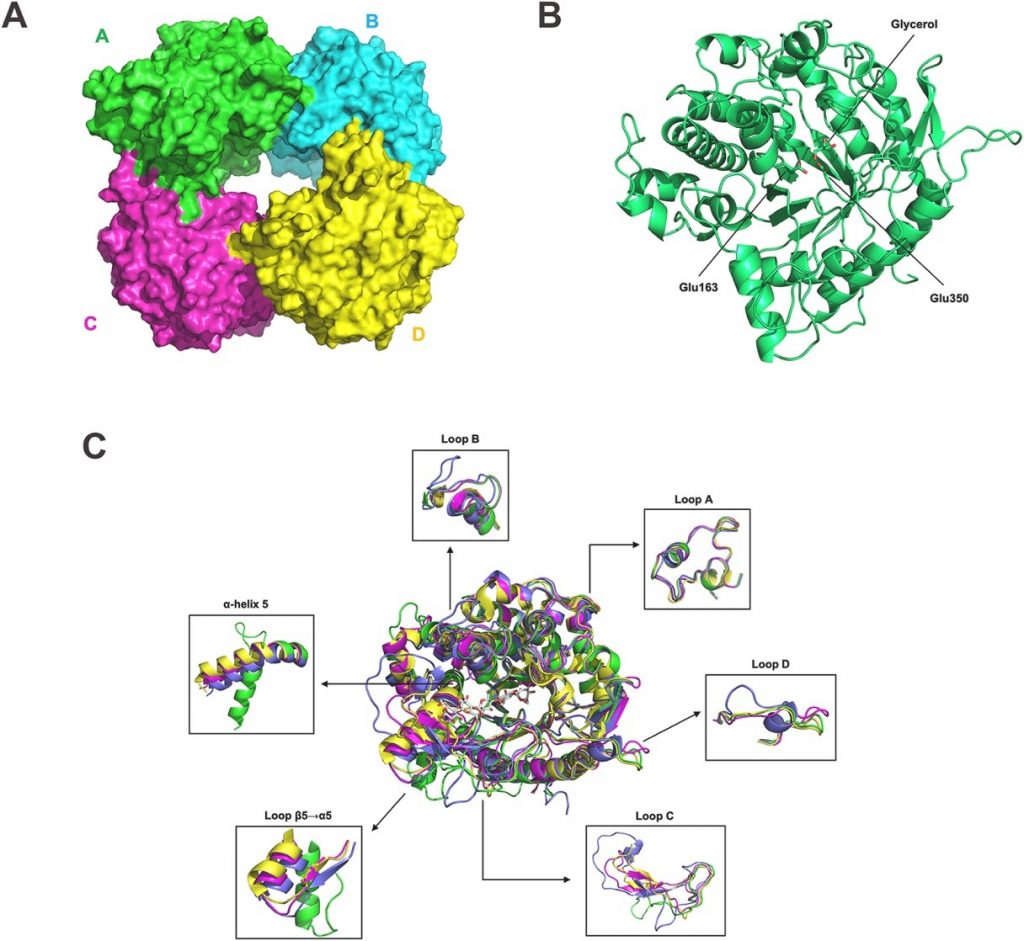
We studied an enzyme called Br2 β-glucosidase, which is found in microbes within the stomach of cows. This enzyme belongs to the glycoside hydrolase family, which helps break down complex sugars into simple sugars like glucose, providing energy for the cow.
Our study revealed that Br2 has a unique structural feature that distinguishes it from other enzymes in the same family, particularly in the regions involved in binding to sugar molecules. These structural differences make Br2 highly effective at breaking down β-1,3-glucans, a key component of plant fiber. However, contrary to initial expectations, Br2 does not efficiently break down cellulose.
To further understand its function, we introduced mutations in specific amino acids of Br2 and examined their effects. Some mutations improved the enzyme’s ability to process certain sugars, particularly those similar in structure to β-1,3-glucans. These findings provide valuable molecular-level insights into how Br2 functions and how its activity can be modified.
This research has significant industrial applications. For example, engineered versions of Br2 could be used to enhance animal feed digestion or to improve the efficiency of biofuel production from plant biomass. Additionally, studying enzymes like Br2 helps us understand the digestive processes of ruminant animals, which could lead to advancements in livestock nutrition and sustainability.
Reference:
Kaenying W., Tagami T., Suwan E., Pitsanuwong C., Chomngam S., Okuyama M., Kongsaeree P., Kimura A., Kongsaeree P.T. Structural and mutational analysis of glycoside hydrolase family 1 Br2 β-glucosidase derived from bovine rumen metagenome. Heliyon, 9 (11), 2023, e21923. DOI: 10.1016/j.heliyon.2023.e2192.