Luluil Maknun, Jitapa Sumranjit, Tuksadon Wutikhun, Ryszard Lobinski, Joanna Szpunar, and Atitaya Siripinyanond*
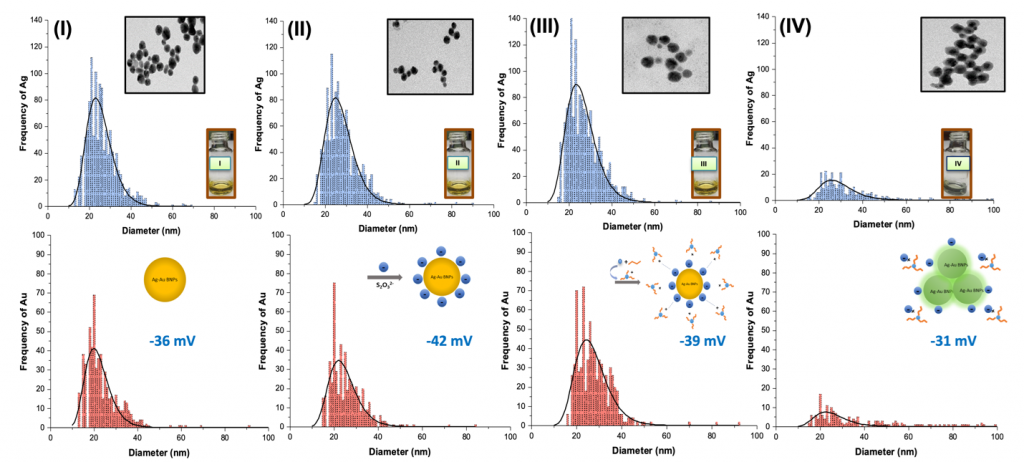
Single particle inductively coupled plasma mass spectrometry (SP-ICP-MS) was applied to monitor the equivalent spherical size and size distribution as well as particle number concentration of Ag and Au during the synthesis of Ag–Au BNPs. The information from SP-ICP-MS were used for understanding the sensing mechanism of Ag–Au BNPs toward Co2+ ion detection based on the aggregation of BNPs. Field-flow fractionation coupled with ICP-MS provided evidence that S2O32− was detached from the Ag–Au BNPs surface through complex formation with Co(en)32+, leading to aggregation of particles. SP-ICP-MS analysis offered the limit of detection (LOD) of Co2+ determination down to 0.6 μg L−1 by using Ag–Au BNPs assisted detection.
Thanks are due to the NSRF via the Program Management Unit for Human Resources & Institutional Development, Research and Innovation [grant number B05F640129]. The support from Center of Excellence for Innovation in Chemistry (PERCH-CIC) and the National Research Council of Thailand (NRCT) and Mahidol University under grant numbers N41A640159 and N11A650144 are also acknowledged. This work is related to the SDGs 6 (Clean water and sanitation).
Reference:
Maknun, L., Sumranjit, J., Wutikhun, T., Lobinski, R., Szpunar, J., Siripinyanond, A. Flow field-flow fractionation and single particle inductively coupled plasma mass spectrometry as a powerful tool for tracking and understanding the sensing mechanism of Ag–Au bimetallic nanoparticles toward cobalt ions (2024) Analytica Chimica Acta, 1301, art. no. 342485, .
DOI: 10.1016/j.aca.2024.342485
