Taweechai Amornsakchai
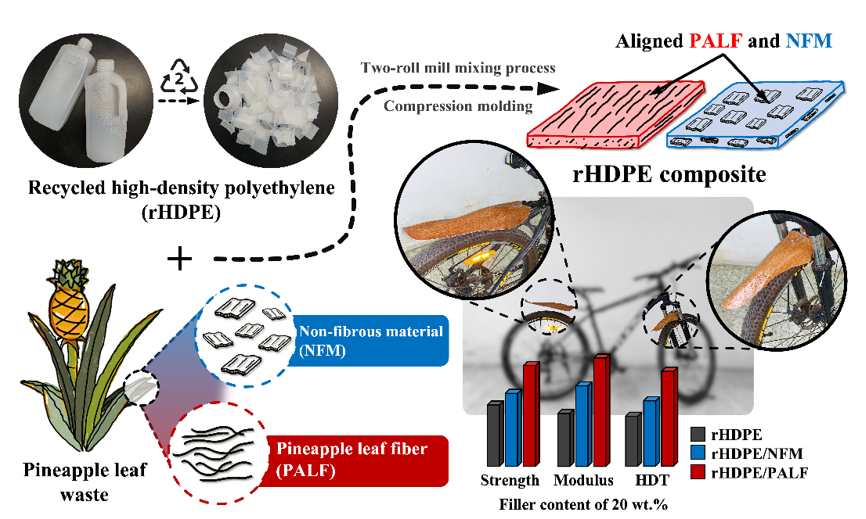
This study investigates the upcycling potential of used high-density polyethylene (HDPE) milk bottles into high-stiffness, high-heat-distortion-temperature (HDT) composites. Recycled HDPE (rHDPE) from milk bottles forms the matrix, and reinforcing fillers are derived from dried pineapple leaves, including fibers (PALF) and non-fibrous materials (NFM). The prepreg is prepared using a two-roll mixer, stacking and pressing it into composite sheets. PALF significantly enhances the flexural strength and modulus, with a 20 wt.% content resulting in a remarkable 162% increase in flexural strength and a 204% increase in modulus compared to neat rHDPE. The rHDPE/NFM composite also shows improved mechanical properties, with both composites exhibiting a slight reduction in impact resistance. The addition of NFM or PALF substantially elevates HDT, reaching approximately 84 °C and 108 °C, respectively, in contrast to the 71 °C HDT of neat rHDPE. Improved compatibility through maleic anhydride-modified polyethylene (MAPE) enhances the overall properties of both composites, highlighting the enhanced performance and environmental friendliness of composites produced from recycled plastics reinforced with pineapple leaf waste fillers.
Reference:
“Upcycling of HDPE Milk Bottles into High-Stiffness, High-HDT Composites with Pineapple Leaf Waste Materials”, Amornsakchai, T.; Duangsuwan, S., Polymers, 2023, 15(24), 4697.