Taweechai Amornsakchai
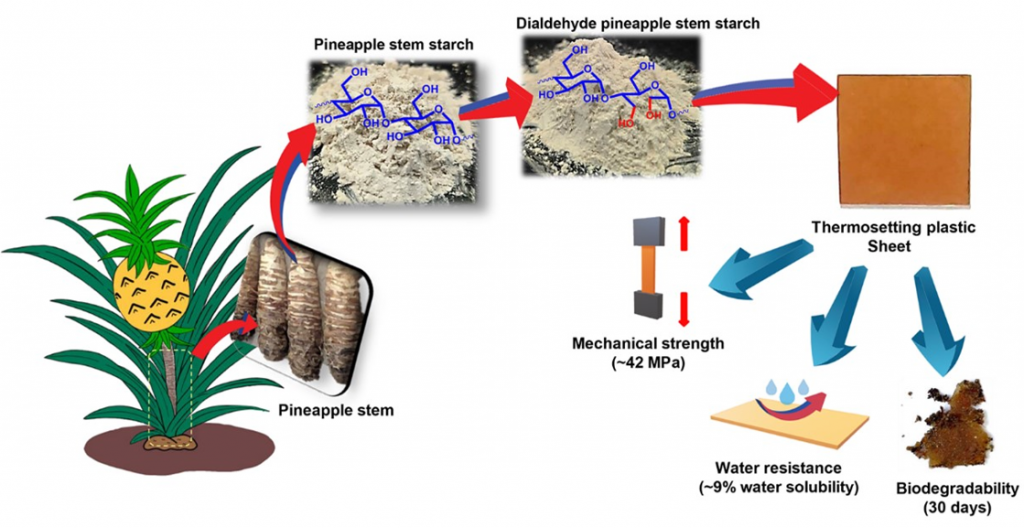
We developed eco-friendly plastics from pineapple stem waste by modifying starch into dialdehyde starch with varying content, achieved through a low-energy consumption process. These dialdehyde starches were then used to create thermosetting plastics, incorporating glycerol as a plasticizer. A direct hot compression molding technique streamlined the process, transforming starch powders into plastic sheets without water-based gelatinization.
The resulting thermosetting plastics exhibited outstanding mechanical properties, featuring a modulus ranging from 1862 MPa to 2000 MPa and a strength from 15 MPa to 42 MPa. Notably, their stretchability remained modest, ranging from 0.8% to 2.4%. Adjusting the glycerol content from 30% to 50% allowed tailoring of the mechanical performance. The thermosets showed a uniformly distributed microstructure, contrasting with the heterogeneous structure of the thermoplastic counterpart derived from unmodified starch.
X-ray diffraction patterns revealed an absence of crystalline structure in the thermosets, suggesting a crosslinked structure. This network formation correlated with enhanced water resistance. Importantly, the thermosetting starch exhibited continued biodegradability after a soil burial test, albeit at a slower rate compared to the thermoplastic counterpart. These findings open avenues for the use of starch-based products, contributing to sustainable alternatives to non-biodegradable petroleum-based materials.
Reference:
“Development of Biodegradable Thermosetting Plastic Using Dialdehyde Pineapple Stem Starch”, Tessanan, W.; Phinyocheep, P.; Amornsakchai, T., Polymers, 2023, 15, 3832.